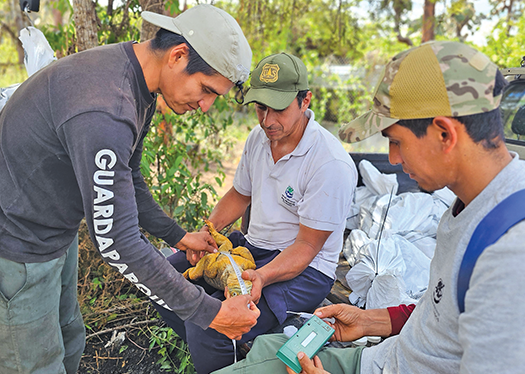
Before their release on Santiago Island, iguanas are measured, dewormed, and implanted with microchips to facilitate monitoring. (Photos courtesy of Galápagos National Park)
Scientists have released 1,500 more yellow land iguanas on the Galápagos island of Santiago, bringing the total relocated there to 6,000 since the Ecuadorian reintroduction program began in 2019.
With five years to go in a program that scientists hope will result in the reintroduction of roughly 1,000 iguanas annually, researchers are optimistic they are well on the way to reestablishing the reptile on Santiago Island.
The yellow land iguana (Conolophus subscristatus) grows up to one meter in length and looks prehistoric thanks to a ridge of spines on its head and back. Naturalist Charles Darwin recorded its presence on Santiago during his visit to the Galápagos Islands in 1835, noting in his journal that it was hard to find a place to camp that was free of the reptiles’ burrows. He was not a fan, describing the iguana as “ugly” and “singularly stupid,” and its movements as “lazy” and “half torpid.”
In 1903 and 1906, expeditions to Santiago conducted by the California Academy of Sciences found no live yellow land iguanas on the island, only their skeletons. Experts attribute the extinction to the introduction and proliferation on Santiago of invasive species including pigs, goats, and donkeys, which have since been eradicated but while on the island destroyed the iguanas’ habitat and ate their eggs and young.
Earlier relocation
Partly to address this situation, scientists in 2019 began moving yellow land iguanas to Santiago from North Seymour, a small island to the southeast. (See “Land iguanas reintroduced on island in Galápagos”—EcoAméricas, Jan. ’19.) But the iguanas were not native to North Seymour, having been moved there in the 1930s from nearby Baltra Island as preparations were being made on Baltra to build a U.S. military base that operated there during World War II.
The shift of iguanas to North Seymour from Baltra was intended to prevent their extinction, but their population skyrocketed in the new location, overwhelming the under two-square-kilometer (0.8-sq.-mile) island’s resources and growing to 9,000 iguanas by 2019, says Christian Sevilla, ecosystems director for Galápagos National Park (PNG).
Sevilla says that by overburdening native vegetation, the North Seymour iguanas put pressure on other plants and animals including cactus finches (Geospiza scandens), lava lizards (Microlophus sp.), blue-footed boobies (Sula nebouxii) and two species of frigatebirds (Fregata magnificens and Fregata minor).
“That’s why we initiated the program of massive reintroduction to Santiago, where ecological conditions are more suitable,” he says.
Santiago is the fourth largest island in the Galápagos chain. Encompassing 585 square kilometers (226 sq. miles), it offers far more extensive habitat and could support 200,000 land iguanas, Sevilla says.
The 1,500 iguanas moved to Santiago most recently were introduced there from August to October of this year, with most of the personnel involved from Galápagos National Park and a smaller number associated with the U.S.-based Galápagos Conservancy.
They were selected after confirming they were in good health while in quarantine for 15 to 20 days at a Galápagos Park facility on Santa Cruz Island. Also while in quarantine, the iguanas were measured, dewormed, implanted with microchips for monitoring and checked to ensure they’d expelled any seeds they’d ingested to prevent the introduction of foreign plant species on Santiago.
Transported in groups of 500 by boat in the cool early hours of the morning to avoid heat stress, the iguanas were observed foraging on their own soon after their release.
International support
The reintroduction program has received financial and technical support from organizations and institutions including the Galapagos Conservancy and the U.K.-headquartered Galapagos Conservation Trust. Both organizations are collaborating with the Ecuadorian government in the project’s logistics, monitoring and follow-up.
Monitoring conducted since 2019 indicates the population of iguanas reintroduced to Santiago is stable, with nests and juveniles in evidence. The program’s goal is to ensure that by 2030, all land iguanas currently on North Seymour are relocated to Santiago so that the former’s ecosystem can recover and the latter can regain its previous ecological balance.
Conolophus subcristatus is one of three land iguana species endemic to the Galápagos. The others are Conolophus pallidus (Santa Fe land iguana), which lives exclusively on Santa Fe Island, and Conolophus marthae (pink land iguana), which lives on Isabela Island’s Wolf Volcano. (See “Galápagos pink iguana subject of increased scrutiny”—EcoAméricas, Dec. ’24.)
Historically, yellow iguanas were native to several islands in the archipelago, including Isabela, Fernandina, Santa Cruz, Plaza Sur, Baltra, and Santiago. Their reintroduction is considered by experts to be a milestone in the conservation of island reptiles and an important step toward restoring ecological processes in the Ecuadorian archipelago.
- Mercedes Alvaro
In the index: The focus of the decade-long relocation project is the yellow land iguana (Conolophus subscristatus)