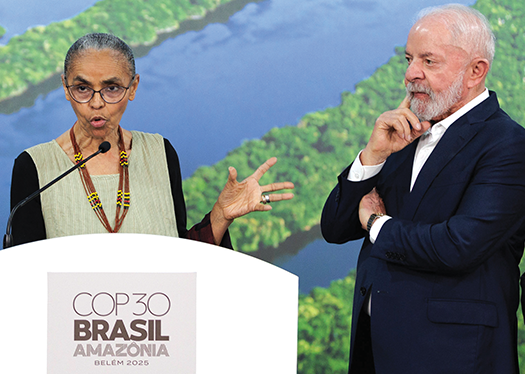
Marina Silva, Brazil’s environment minister, speaks at COP30 as Brazilian President Luiz Inácio Lula da Silva looks on. (Courtesy photo)
Preparing to host November’s COP30 climate summit, Brazil picked the Amazon river port of Belém as the venue, apparently hoping proximity to the world’s largest tropical rainforest would inspire delegates to make the UN-sponsored conference a success. As talks concluded on Nov. 22, one day past their official 12-day schedule, Brazilian President Luiz Inácio Lula da Silva did claim some positive results. In particular, he noted delegates ratified the key objective of the Paris Agreement produced a decade ago in COP21: to keep global temperatures from rising 2.0º Celsius higher—and preferably no more than 1.5ºC higher—than their pre-industrial levels.
But Lula had to admit that delegates from the 194 countries represented at this year’s conference failed to make new, concrete commitments to limit greenhouse-gas emissions and transition away from fossil fuels. Nor, he acknowledged, did they act to make real the still largely aspirational goal—agreed at COP29 and echoed in Belém—to mobilize US$1.3 trillion annually in public and private funding for climate initiatives in developing nations.
“Climate change is not simply a matter of environmental policy,” Lula said on Nov. 22, while attending the annual summit of G20 nations in South Africa. “It is, above all, a challenge of economic planning. Priorities are reversed. It is inconceivable that we cannot mobilize climate finance while twice that amount is allocated to military spending.”
That COP30 failed to make breakthroughs was unsurprising considering the backdrop of skepticism created in no small part by the latest U.S. withdrawal from the Paris Agreement and U.S. President Donald Trump’s ongoing hostility to international climate-protection engagement and support.
But the climate financing issue is becoming increasingly urgent for Latin American and Caribbean countries. These nations collectively account for less than 10% of global greenhouse-gas emissions, yet are disproportionately exposed to climate-change impacts ranging from hurricanes and drought to glacial melt and sea-level rise. And while work on a final COP30 document extended a day beyond the summit’s official Nov. 10-21 timeframe, the statement Belém conferees ultimately produced marked a retreat from the core climate-protection challenge: curbing use of fossil fuels.
At COP28, held in Dubai in 2023, conferees forged an agreement that called for “transitioning away from fossil fuels.” But at the recent Belém summit, negotiators made no mention of the concept in the final declaration, though it had been present in earlier drafts of the document. Instead, the final Belém political agreement—called the Mutirão Decision after a Portuguese word of Indigenous Brazilian origin meaning “collective effort”—combines a specific statement of the overarching goals without mapping a clear strategy for achieving them.
“[L]imiting global warming to 1.5°C,” the declaration reads, “requires deep, rapid and sustained reductions in global greenhouse gas emissions of 43% by 2030 and 60% by 2035 relative to the 2019 level and reaching net zero carbon dioxide emissions by 2050.”
Conference organizers acknowledged the lackluster results and unfavorable political context, but they insisted that COP30 participants came away with strong reasons to persevere.
“We knew this COP would take place in stormy political waters,” said UN Climate Change Executive Secretary Simon Stiell in his closing speech at the conference. “Denial, division and geopolitics has dealt international cooperation some heavy blows this year.” Yet Stiell noted: “COP30 showed climate cooperation is alive and kicking, keeping humanity in the fight for a livable planet, with a firm resolve to keep the 1.5°C within reach. I’m not saying we’re winning the climate fight. But we’re undeniably still in it, and we’re fighting back.”
Underscoring COP30’s stated resolve to limit global warming to 1.5°C higher than pre-industrial temperatures, he added that despite the U.S. absence, “194 countries representing billions of people have said in one voice that the Paris Agreement is working.”
Some countries pushed for a more ambitious action plan, with Colombia—supported by regional partners Panama and Chile—a prominent leader of that effort. Daniela Durán, who headed Colombia’s delegation, reminded conference delegates in a speech that “75% of global carbon emissions come from fossil fuels” and added: “There is no mitigation if we cannot discuss the transition away from them.”
Dire analysis
Two days after the conference, Colombian President Gustavo Petro posted a stark commentary on social media, saying: “Either fossil capitalism survives, and drags humanity to its grave, or a green capitalism emerges.”
The Colombian president termed the absence in the final agreement of any mention of fossil fuels “an affront to humanity.” Blaming the outcome on pressure from Middle East oil-producing nations, the European Union, the African Union, and Brazil and Mexico, Petro added: “I oppose [the final agreement] as the representative of the Colombian nation.”
During the conference, Colombia attracted 24 votes for a proposal to recognize fossil-fuel use as incompatible with climate protection and to work collectively to accelerate a “just, orderly and equitable transition away” from them. In partnership with The Netherlands, Colombia also proposed an international conference on curbing fossil-fuel use, a meeting that will be held April 28 and 29 in the country’s Caribbean coastal city of Santa Marta.
“This COP further highlighted the gap between countries in the Global South and industrialized nations, which have failed to make progress on a plan to phase out fossil fuels,” Vanessa Torres, deputy director of the Colombian organization Environment and Society, told EcoAméricas in Belém. “Otherwise, it’s impossible to understand why the elephant in the room in the climate change debate—oil—has been swept under the rug.”
During the first week of COP30, the so-called People’s Summit was held simultaneously in Belém, bringing together social, small-farmer, and Indigenous organizations outside the COP venue. On Nov. 15, it staged a march through the streets of Belém that drew thousands of people, including two ministers from Lula’s government—Environment Minister Marina Silva and Indigenous Affairs Minister Sonia Guajajara.
People’s Summit demand
The People’s Summit delivered a document to COP30’s president, Brazilian diplomat André Correa do Lago, demanding an end to fossil-fuel use and asserting that “the air, forests, water, land, minerals, and energy sources cannot remain private property or be appropriated, because they are common goods of the people.”
Maureen Santos of Brazil, an organizer of the People’s Summit, called the gathering the biggest demonstration held at a COP, but she did not hide her disappointment in the climate summit itself. “Of course the results of the conference are not what we wanted,” Santos said. “The exit of the United States, which is the most responsible for climate change, created many difficulties because the other countries don’t want to assume the mitigation and adaptation responsibilities alone.”
Argentine Juan Carlos Villalonga, president of the nonprofit, Brussels-based Global Legislators Organization for a Balanced Environment, agreed, suggesting the challenge now is for each country to work to reach the voluntarily pledged emissions targets it has set under the Paris Agreement process.
“I understand we must stop waiting for solutions from the COP; first, because all necessary agreements on how to implement the Paris Agreement have been reached—there are no major regulatory hurdles left to untangle—and second, because there is a lot of economic pressure against moving forward, and the countries’ delegations arrive at the COP with very little room to maneuver,” Villalonga told EcoAméricas in Belém. “Today, the solutions lie within each country and depend on each one’s willingness to fulfill its commitments.”
Sidebar: At COP30, Brazil advances sustainable-fuels and forest initiatives
While hosting the recently concluded COP30 conference, Brazil promoted a pair of climate-related initiatives with special relevance for Latin America—one to sharply expand production of non-fossil fuels and the other to spur a market-based means of rainforest protection.
In a proposal it dubbed “Belém 4x,” Brazil targeted sustainable fuels, an area that experts say could be of great benefit to Latin American countries with large agricultural capacity, ample renewable-power potential or—as in the case of Brazil—both.
The initiative aims by 2035 to at least quadruple the output of fossil-fuel alternatives such as hydrogen and its derivatives, biogases, biofuels, and synthetic fuels. The proposal won the support of 27 countries—including Mexico, Chile, Guatemala, Canada, Panama, and Costa Rica.
An International Energy Agency (IEA) report distributed alongside the proposal buttressed Brazil’s case, indicating that sustainable fuels complement electrification and hold particular promise in land, sea, and air transport.
The report further asserted that production of alternative fuels could be a catalyst for economic and social development in countries of the Global South.
In its proposal, Brazil focused mainly on liquid biofuels made from agricultural raw materials, a focus that likely explained in part, at least, the large presence of farm-sector representatives at the conference.
At various COP30 events, academics associated with agribusiness presented papers arguing that it is possible to double biofuel production without causing forest-unfriendly expansion of the agricultural frontier. This could be done, they asserted, by improving the productivity of six currently cultivated crops—corn, sugarcane, wheat, soybeans, palm, and rapeseed.
Today, Brazil is the world’s second-largest producer of biofuels after the United States, accounting for 26% of global ethanol production and 12% of biodiesel production, according to IEA data. This year, the Brazilian government increased the mandatory ethanol blend in gasoline from 27% to 30% and the biodiesel blend in diesel from 14% to 15%. And pure ethanol, made from sugarcane, is widely available for sale in Brazil for flex-fuel vehicles, which can run on any blend of ethanol and gasoline.
“Every region of the world has a different situation regarding renewable energy,” said Roberto Mattarazzo, director of corporate communications for the Brazilian division of automotive giant Toyota, which is introducing vehicles in Latin America that can run on 100% ethanol. “A single technology cannot be chosen for everyone. Given the availability of agricultural raw materials and its vast territory, which makes installing electric-vehicle charging infrastructure difficult, biofuels are the solution for Brazil, as they are for other countries in the region.”
Evandro Gussi, president of the Brazilian Sugarcane and Bioenergy Industry Union (Unica), said his country has the agricultural productivity, technological innovation, and public policies to lead the global expansion of biofuels. “The Brazilian model,” he asserted, “is exportable and replicable in other parts of the world.”
Profit-driven forest protection
Brazil also used COP30’s stage to roll out what it hopes will become a powerful market-based fund for tropical forest conservation around the world.
First proposed by Brazilian President Luiz Inácio Lula da Silva at the 2023 COP28 climate summit held in Dubai, the forest-protection financing plan is called the Tropical Forest Forever Facility (TFFF). It aims to attract US$25 billion in public capital from developed-nation governments and US$100 billion in private capital from institutional investors such as banks, insurance companies, and employee-pension, mutual and hedge funds.
The capital will be invested in world financial markets in hopes of generating above-market returns. A portion of those returns will be used to pay investors, and the bulk of the rest—an estimated US$4 billion a year—will go to tropical countries as a long-term source of funding for forest protection programs.
In September, the Brazilian government made the first US$1 billion investment in the fund. Organizers hoped that rollout of the fund at COP30 would attract large foreign-government “seed” commitments aimed at helping the facility reach its overall US$125 billion capitalization goal. Those commitments, including Brazil’s US$1 billion investment, now total US$6.7 billion, according to a TFFF post-conference statement.
The countries that made pledges at COP30 include Norway (US$3 billion over 10 years), Germany (US$1.15 billion over 10 years), Indonesia (US$1 billion), France (US$580 million between now and 2030), The Netherlands (US$5 million), and Portugal (US$1 million). The French and Norwegian commitments were subject to conditions, but experts say that in both cases these would not be difficult to meet.
Some environmental advocates describe the commitments made at COP30 as disappointing. But Carolina Grottera, undersecretary for ecological transition at the Brazilian Finance Ministry, told EcoAméricas that Brazil never expected TFFF investment commitments at COP30 to reach the US$25 billion target the fund has set for public investment capital and is “very satisfied” with the US$6.7 billion pledged so far.
“Brazil made it clear that it expects to reach the US$25 billion in [public] commitments in the next two or three years, and [Brazilian] Finance Minister Fernando Haddad has said [the TFFF] would likely only receive US$10 billion of this total by the end of 2026. What’s more, Brazil is in advanced conversations with other developed countries about their possible commitments to the TFFF.”
- Daniel Gutman and Michael Kepp
In the index: Representatives of 194 countries converged on Belém, Brazil, for COP30. (Photo courtesy of COP30 Brazil)