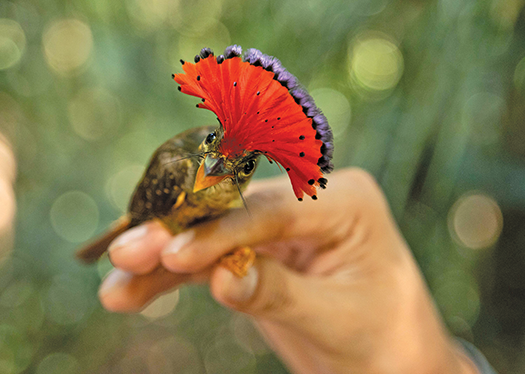
Amazonian royal flycatcher (nychorhynchus coronatus) (Photo by Emilia Roberts of George Mason University for the Biological Dynamics of Forest Fragments Project)
In 2022, a team of researchers published puzzling findings on bird abundance in Panama. The study, published in Proceedings of the National Academy of Sciences (PNAS), found tropical bird populations had fallen by more than 50% over the 44-year period 1977 to 2020. While global bird population declines are largely driven by habitat destruction, the drop observed in the study occurred inside Soberanía National Park, an area covering 22,000 hectares (54,363 acres) of nearly intact, protected forest.
The results matched similarly surprising findings produced by long-term, tropical-bird population studies in Latin America. A study published in 2021 in Ecology Letters found eight tropical bird species had declined 50% over a 35-year period at a remote Amazonian research site in Brazil. In 2015, scientists working in Ecuador’s Yasuní Biosphere Reserve, one of the most biodiverse places in the world, found that capture rates of birds had declined by 40% since 2008. Research released last year from the same site found that bird populations had declined by 50% over 22 years.
“What happens is that in those three places, they found the same pattern: that birds in tropical forests—mainly understory birds—are declining, and they don’t know why,” Henry Pollock, a wildlife biologist and lead author of the Panama study, told EcoAméricas. “No one knows why.”
A growing body of research points to a likely culprit: climate change. A recent study published in Nature Ecology & Evolution found climate change responsible for a 25–38% decline in tropical bird populations since 1950. By combining data from long-term bird studies and climate records, the research team estimated the decline in bird abundance attributable to climate change, compared with a hypothetical world without it. The region most affected is the tropics.
“Across tropical regions, including in South America, climate change is likely already having substantial negative impacts on bird populations, and that’s a massive problem for the biodiversity of the region,” said study co-author Maximilian Kotz, a scientist at the Potsdam Institute for Climate Impact Research in Germany and Spain’s Barcelona Supercomputing Center.
According to Kotz, the Nature Ecology & Evolution study underscores how climate change is exacerbating the biodiversity crisis. By 2100, one-third of all species may face extinction if greenhouse-gas emissions are not curbed.
Tropical birds were chosen as the focus of the study because of the relatively extensive data available on bird populations globally, though more counts are needed in regions such as Latin America. Tropical birds are also especially vulnerable to climate change. Having evolved in stable environments with the same climate conditions year-round, they are sensitive to rapid environmental shifts such as changing patterns of temperature and rainfall. Extreme heat is especially dangerous because birds cannot sweat. Studies show that it can increase mortality, reduce fertility, alter breeding behaviors and reduce offspring survival, all of which may shrink populations.
The decline of tropical birds also has wider ecological implications given the important role birds play in sustaining forest ecosystems by pollinating flowers, dispersing seeds, controlling insects and performing other functions. With tropical birds inhabiting some of the most pristine and carbon-rich forests in the world, scientists warn that their decline could have a significant deleterious effect on these ecosystems. According to a 2022 study based on research in the Brazilian Amazon, a reduction in tropical bird populations could compromise the resilience of primary rainforests due to the loss of ecological services birds typically provide.
While the recent climate-attribution study does not pinpoint exactly how extreme heat affects tropical birds, scientists in South America are testing various hypotheses. At a site near the Amazonian city of Manaus, Brazil, where the 2021 study was conducted, about 50% of 79 species declined over a 35-year period, with insect-eaters hit especially hard. The results prompted new questions as scientists tried to understand the cause of the decline. They examined whether pathogens, parasites, increases in predators or exposure to PFAS, chemicals widely used in everyday products, might be responsible.
None of the tests, however, supported these hypotheses. Climate change loomed as the most likely explanation, and many experts now support that view.
“ At our study site, if it’s not climate, I don’t know what it is,” said David Luther, an associate professor in biology at George Mason University and a researcher at Manaus’s Biological Dynamics of Forest Fragments Project.
A separate Science Advances study, co-authored by Luther, draws on 27 years of data from the Manaus site. Researchers found that increasingly severe dry seasons characterized by higher temperatures and less rainfall were directly linked to lower bird survival. During the study period, dry season temperatures rose by about 1°C and rainfall dropped by around 10 millimeters, creating harsher conditions for understory birds adapted to the cooler microclimates found among shrubs and smaller trees. The model estimated that a 1°C increase in average dry season temperature could reduce their chances of survival by about 63%.
“ Hotter temperatures and reduced rainfall lead to reduced survival,” said Luther of the findings produced by the Manaus project, a joint effort by the Panama-based Smithsonian Tropical Research Institute, and Brazil’s National Museum of Natural History and National Institute for Amazonian Research. “ The mechanism that causes them to survive less, we are investigating now.”
Luther said that several explanations are possible: the dry season may directly impact birds by increasing mortality or by limiting their ability to find food for their young, which disrupts their reproduction process. Or the impact may be indirect: the extreme conditions may reduce birds’ food sources—particularly insect populations which are also vulnerable to climate change. It’s also possible that multiple factors are in play.
To help answer the question, Luther and his team have been conducting large-scale experiments in the rainforest over the past two years. For example, U.S. and Brazilian researchers are watering a controlled area of the rainforest during the dry season, ensuring water is present in the same amounts recorded in the 1980s, he says. The aim is to compare this irrigated site with untreated areas to understand how reduced rainfall and hotter temperatures influence bird survival.
Various means are being used to measure impact. To track population changes, the team listens to birds’ chirps, observes their movements using camera traps, and monitors their feeding with field sensors, said Jared Wolfe, a wildlife ecologist and professor at Michigan Technological University, who is leading the fieldwork. They use mist lines to capture birds and draw blood samples to see if they are breeding.
“ It’s pretty unprecedented [research],” Wolfe says. “People have done a lot of this work at smaller scales focused on plants, but never one at a larger scale focused on wildlife.”
Long-term bird studies, such as the one conducted in Manaus, are needed, but exceedingly rare in the tropics, compared to regions like North America and Europe, said Pollock, coauthor of the Panama study. According to his estimates, five long-term monitoring sites exist throughout Latin America—two in Ecuador, one in Peru, one in Panama, and one in Brazil. He said that multiple factors are likely contributing to the birds’ decline, but suspects that climate change and its impact on insect survival is likely a main driver. Determining definitive causes will require further experiments throughout the region, which Pollock acknowledges are expensive and difficult to fund in Latin America.
“You have to follow individuals for years,” Pollock says. “You need variation in the climate, the environment, rainfall, and you have to keep track of those individuals and see what happens to them as conditions change. It’s the only real way to understand why species are in decline.”
The growing body of research linking declining bird abundance to climate change also poses a dilemma for conservationists. Even in areas far from human development, where policies are in place to protect tropical forests, bird populations are shrinking. In some research sites, such as Panama’s Soberanía National Park, the decline was so severe that nine species are now likely locally extinct or present only in very low densities. Their loss raises the question of what sort of actions governments and conservation groups can take to protect vulnerable species.
“ We want to think that by protecting these ecosystems from things like deforestation, we can keep them safe,” Kotz says. “But this is starting to imply that with climate change ongoing, that’s not going to be enough. Essentially, we’re going to need to also stop climate change or provide ways to help these species adapt.”
Experimental solutions
Globally, some scientists are experimenting with climate change adaptation solutions to protect birds from extreme heat. In South Africa, for example, the international conservation group World Wildlife Fund (WWF), together with the University of Cape Town and South African National Parks, built structures to provide bird species with shade in one of the country’s hottest deserts. Installed near watering holes, the structures aim to lower ground surface temperatures and allow the birds to safely access water. A 2023 study conducted by University of Cape Town researchers found that birds responded positively to the structures, visiting the shaded sites more frequently than they did unshaded control sites.
Luther says that the experiments in Manaus will help clarify which adaptation strategies could be effective in rainforests. Previous studies show that the birds most affected by extreme heat live in the understory, where shade is guaranteed. Part of the aim of the rainfall manipulation experiment is to determine how much of a difference additional water will make for the birds and for the wider ecosystem during the dry season. The results could help guide designs for a climate-change adaptation plan in the central Amazon.
So far, however, climate adaptation pilot projects like those in South Africa are rare or nonexistent in Latin America, according to experts. ”It’s a newly defined space that researchers and conservation managers really need to start thinking about,” Luther said. For now, most NGOs are directing their efforts toward habitat preservation rather than climate change adaptation plans. “It’s hard to get to the point of ‘how do we mitigate climate change’ when we’re still at the point of ‘that forest is gonna get cut down within two years and, after that, who cares if the climate changes because the species are already gone,’” Luther said.
Habitat conservation still key
Conservationists argue that habitat preservation could nevertheless prove crucial in protecting birds amid rising temperatures—particularly when protected areas are designed to link different ecosystems.
Guido Berguido, a biologist and director of AdoptaBosque, a conservation group in Panama, notes that although birds are vulnerable to extreme heat, they still have the possibility of moving to cooler elevations to escape rising temperatures. In areas like Panama’s Soberanía National Park, where decades-long monitoring has documented steep declines in bird populations, maintaining forest connectivity will be key, Berguido said. “By having some degree of connectivity with other ecosystems, bird species could have the option to move from one place to another: from a lowland forest to a highland forest, where the conditions may be more suitable for them,” he said.
Still, experts stress that the most urgent priority is global climate-policy reform. While policy changes will not protect birds immediately, they are vital for their survival in the long run. “ Unless we stop climate change through a renewable-energy transition and getting to net zero emissions, these kinds of effects will just get worse,” Kotz says. “Even if we implement certain adaptation strategies, if climate change continues, then we’ll have to sort of up the ante of those adaptation metrics because of the heat extremes that these birds will be experiencing.”
Berguido asserts studies linking climate change to declining bird abundance will help drive policy change since they will provide decision makers with hard evidence that climate change is real and already taking a toll on wildlife. Says Berguido: “It’s an emergency call, a cry of desperation, that shows nature is suffering.”
- Christina Noriega
In the index: White-plumed antbird (Pithys albifrons) (Photo by Emilia Roberts of George Mason University for the Biological Dynamics of Forest Fragments Project)