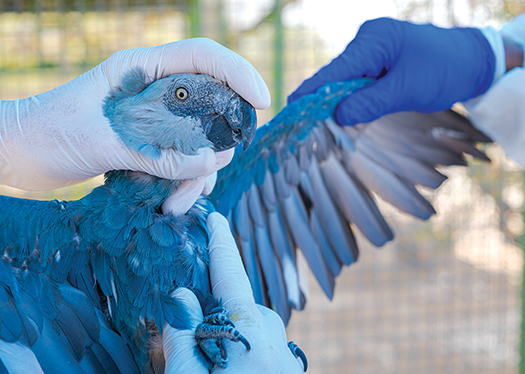
A Spix’s macaw undergoes examination at the breeding center operated by BlueSky Caatinga. (Photo by ICMBio/Miguel Monteiro)
Brazilian authorities recently ordered the country’s only breeding center for the Spix’s macaw to adopt emergency measures to stop the spread of an incurable, often fatal circovirus threatening the critically endangered parrot species.
The action by ICMBio, the conservation arm of Brazil’s Environment and Climate Change Ministry, has fueled a bitter dispute between the agency and BlueSky Caatinga, the private company that runs the breeding center in the northeastern state of Bahia.
ICMBio asserts the center was irresponsibly slow to adopt biosafety measures after a Spix’s macaw tested positive for the disease in April. In November, ICMBio wildlife specialists visited the breeding center accompanied by Federal Police, fining BlueSky Caatinga R$1.8 million (US$330,000) for noncompliance with biosafety protocols.
It has also ordered the breeding center to take emergency steps, such as daily disinfection of facilities exposed to bird feces. In early December, Federal Police began their own investigation of the center’s biosafety practices, confiscating employees’ mobile phones and computers in the process.
The center has asserted in a prepared statement that it “always complied with all biosecurity standards,” going on to say that “all 103 macaws living at the location are receiving appropriate care.”
But the response has not mollified ICMBio officials—among them Cláudia Sacramento, coordinator of epizootics. In an interview with EcoAméricas, Sacramento said the problem “could have been prevented had BlueSky Caatinga not been so lax and so slow in notifying us about the disease outbreak and in adopting biosafety measures to prevent its spread.”
The circovirus affecting some of the center’s Spix’s macaws causes highly contagious Psittacine beak and feather disease, a condition that was first described more than four decades ago in Australia and has since been spreading to parrot populations around the world. Sometimes fatal, the disease is associated with plumage discoloration, feather malformation and loss, as well as beak and claw deformities.
Before a bird tested by the center in April was found to have the circovirus, there had been no registered cases of the Psittacine beak and feather disease in Brazil, ICMBio says.
Since 2010, ICMBio has led a highly publicized effort to reintroduce the Spix’s macaw (Cyanopsitta Spixii) in its native habitat—the Caatinga, a scrubland biome in northeastern Brazil featuring winding riverbank gallery forests. (See “Brazil prepares way for Spix’s macaw reintroduction”—EcoAméricas, July ’15.)
Dedicated reserve
In 2018, it created a 29,234-hectare (72,237-acre) conservation reserve in the Caatinga—the Wildlife Refuge for the Spix’s Macaw, or Refúgio de Vida Silvestre da Ararinha-azul—for the vibrant-blue bird’s reintroduction.
In 2020, ICMBio opened the breeding center in partnership with the Association for the Conservation of Threatened Parrots (ACTP), a German nonprofit that provides the center with macaws for breeding. The center at the reserve is currently operated by BlueSky Caatinga under a management contract.
The Spix’s macaw became extinct in the Caatinga—its only native habitat—after centuries of destruction by ranchers of the region’s gallery forests and, starting in the 1960s, extensive wildlife trafficking. The last wild Spix’s macaw sighting occurred in 1991. Because breeding centers around the world maintained a sizable number of the birds, however, ICMBio thought it possible to reintroduce the Spix’s macaw into its native habitat.
ICMBio’s dispute with BlueSky Caatinga grew out of the April 2025 discovery by breeding center employees that a Spix’s macaw fledgling born in the wild in the reserve showed circovirus symptoms—feather discoloration and difficulty flying. The bird, whose parents were among the first 22 Spix’s macaws released into the reserve in 2022, was captured and tested in April, and found to be infected with circovirus. It was not immediately quarantined, however, and ICMbio was not notified of the positive test until mid-May, according to ICMBio.
ICMBio says that when it learned of the test, the fledgling had already been in contact with 20 Spix’s macaws at the center—14 of which tested positive for circovirus. ICMBio says it ordered quarantines of all 15 infected birds. Since then, five more macaws at the center and 11 more living in the reserve have tested positive for the circovirus. Those have been quarantined, too, meaning 31 of the 103 Spix’s macaws currently in the center are in isolation.
Center pushes back
The breeding center, in a statement emailed to EcoAméricas, took issue with ICMBio’s account.
“As soon as tests confirmed detection [of the circovirus], the breeding center spontaneously notified the environmental agencies, suggested management measures, and awaited further guidance,” the statement said. “At no time was there a deliberate decision to place an animal with a positive test result in contact with animals without such a result; isolation was implemented immediately within the available structural capacity.”
The circovirus outbreak has put not only BlueSky Caatinga in the spotlight, but also ACTP. In January 2025, ACTP sent the center 41 birds for breeding. One had tested positive for circovirus earlier that month, but a week later tested negative, according to an ICMBio report published in September 2025.
Sacramento says this does not prove that circovirus entered the country with the January macaw shipment. ACTP, for its part, did not respond to an EcoAméricas request for an interview, but Cromwell Purchase, the nonprofit’s research director and a participant in the Caatinga reintroduction project, addressed the question during a webinar in October.
“We certainly didn’t bring the circovirus into Brazil, something that meant nothing to the Brazilian government, which has its own agenda,” Purchase said in the webinar. “It believes that every positive [circovirus test] is positive because it thinks there is no such thing as a false positive and that every negative is a false negative. [This agenda] put us up against Mafia tactics or, I guess, government tactics, how government authorities use intimidation to get what they want.”
- Michael Kepp
In the index: Spix’s macaw (Photo by ICMBio/ Miguel Monteiro)
ICMBio press release on Spix’s macaws testing positive for circovirus (in Portuguese): link