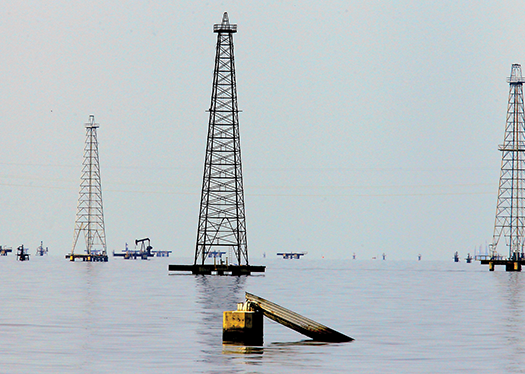
In Lake Maracaibo, signs of the degradation of Venezuela’s oil infrastructure abound. (Photo by Donnebryant/Shutterstock)
Donald Trump’s plan to take over Venezuela’s decrepit oil industry and ramp up production signals an alarming commitment to fossil fuels and could significantly increase the Latin American country’s output of climate-warming gases, energy experts and environmental advocates say.
The Trump administration has called on American oil companies to revamp Venezuela’s oil infrastructure and double, or more than double, production. Trump says the United States will “run” Venezuela and control the sale of the country’s oil, which is under U.S. sanctions.
“This move sends a dangerous signal that the U.S. is willing to use military might to entrench and prolong the fossil-fuel era,” says Nikki Reisch, climate and energy program director at the Center for International Environmental Law (CIEL), a Washington, D.C.-based research organization. “It goes directly against the interests of the U.S.—his own population—which is increasingly facing the consequences of the climate crisis.”
While the United States is not alone in seeking to increase oil output, Trump’s gambit presents a particular climate risk because Venezuelan crude is heavier and more sulfurous than other crudes, experts say. The oil requires more processing to extract and refine, which produces more greenhouse gases.
What’s more, says Reisch, Trump’s plan violates America’s international obligation to fight climate change. The International Court of Justice last year declared that all states are obliged to prevent “significant harm to the climate system,” regardless of whether they are party to climate agreements.
Says Reisch, “A new scramble to expand oil production is not just unwise, it is unlawful.”
Venezuela has some 300 billion barrels of proven oil reserves, the largest in the world. The country’s oil output exceeded 3 million barrels per day (BPD) in the late 1990s. But production has fallen over the past 20 years due to mismanagement and underinvestment.
The decline began under the government of Hugo Chávez and accelerated during the 12-year rule of President Nicolás Maduro, who was captured along with his wife, Cilia Flores, by the U.S. military in a Jan. 3 pre-dawn raid ordered by Trump. The couple was jailed in Brooklyn, New York, pending trial on drug and weapons charges.
Experts reckon that, with U.S. investment, Venezuela could add up to 500,000 bpd in two to three years; it would take a decade and $100-$180 billion to reach 3 million bpd, they say. Given that timeline, Trump’s plan “only makes sense if you’re betting on a future of fossil-fuel dominance and an unlivable climate,” Allie Rosenbluth, U.S. program manager for Oil Change International, a Washington, D.C.-based research and advocacy organization, wrote in an email to EcoAméricas.
Heavy and dirty
Venezuelan output would also be highly polluting, Rosenbluth notes. Extracting and transporting the tar-like crude from the Orinoco Oil Belt involve techniques such as injecting steam and diluting the oil with a lighter hydrocarbon so it flows through pipes more easily.
Patrick King, vice president for emissions research at Rystad Energy, a Norwegian consultancy, calculates that extracting a barrel of Venezuela’s very heavy crude produces around 90 kilograms of carbon dioxide equivalent. That compares to an average of about 35 kilograms globally. The emissions calculation is based on the energy needed to extract crude from the reservoir combined with emissions from burning off gas associated with oil production.
The International Energy Agency (IEA) estimates Venezuela’s gas-flaring intensity—the amount of gas burned for each barrel of oil produced—is 10 times the global average. The country accounted for 3,580 kilotons of methane releases in 2024, nearly half of all methane emitted by the fossil-fuel sector in Central and South America, according to the IEA.
Yet American oil companies could improve the efficiency and environmental record of the country’s oil and gas operations, which are currently run by the state oil company Petróleos de Venezuela and are notorious for spills, leaks and astronomical methane emissions.
Ultimately, Trump’s goals may be defeated by economics, energy experts say. Extracting and refining Venezuelan oil is expensive, the decay of the oil industry has been profound and the security and political environment in Venezuela is very unstable.
“Are you going to find investors who are willing to make this kind of investment?” says Ana Carolina González, senior director for programs at the Natural Resource Governance Institute, a New York City-based nonprofit whose focus is improved management of world oil, gas and mineral resources. Oil companies have options in countries that have lower production costs and fewer risks, she says, adding, “There’s a lot of skepticism.”
Objectives beyond oil
Trump also has his eye on Venezuela’s deposits of metals, minerals and rare earth elements, which are sought after by the technology and defense industries, González says.
But these are also problematic. The size and availability of deposits are unclear, says González, due to a lack of official data. Meanwhile, the country’s formal gold and bauxite mines are state-owned and run down; and a huge swath of southern Venezuela, called the “mining arc,” is a hotbed of illegal prospecting by armed groups and criminals who dig for gold, bauxite, coltan and other minerals.
Putting aside legal questions about the U.S. intervention in Venezuela, a more orderly development of the country’s minerals could reduce environmental damage caused by extraction, including deforestation and pollution, says González. But this would require “a government that sets standards, that defines the mechanism for enforcing them, and that defines where you can and can’t explore.”
And while Venezuela’s minerals might be an appealing spoil for the U.S., they won’t solve Venezuela’s long-term need for a robust economy that does not depend on a single resource. Says González, “You can’t just switch oil for minerals and think this is a productive, sustainable alternative.”
Whether Trump succeeds in winning Venezuelan oil or minerals, the intervention has compromised U.S. credibility, Rosenbluth says. She adds: “It makes the U.S. look reckless and out of step with democratic systems and the global shift toward clean energy.”
- Victoria Burnett
In the index: Leaky oil infrastructure is an ongoing problem in Venezuela. (Photo by JBula_62/Shutterstock)
International Court of Justice advisory opinion stating that all states are obliged to prevent “significant harm to the climate system,” regardless of whether they are party to climate agreements: link