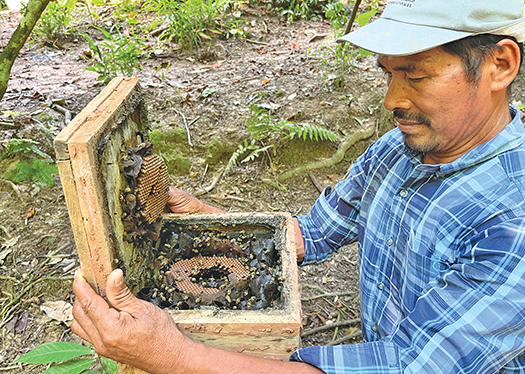
Heriberto Vela examines a hivenear his home in San Francisco, on the Marañón River near Nauta, Peru. (Photo by Barbara Fraser)
One of the first things a visitor sees along the path to Heriberto Vela’s house in the tiny community of San Francisco, on Peru’s Marañón River, is a hand-lettered sign: “Remember that without bees there is no life.” Nearby is a scattering of small square boxes on platforms mounted on poles, each with a tin or palm-thatch roof resembling those of the houses in this Amazonian community. You have to look closely to see the activity—a constant stream of bees, some so tiny that half a dozen or more would fit on your fingernail, buzzing in and out of the boxes where they’ve built their hives.
Vela’s hives house five species of bees of different colors and sizes, all native to the Amazon and all without stingers, although they can bite with their tiny teeth if annoyed. Small enough to be easily overlooked amid the vegetation, they are nonetheless crucial to the survival of the rainforest as well as local agriculture. Native stingless bees are prolific pollinators of at least 80% of the region’s wild flowering plants and some 70% of crops, including commercially important ones like coffee and cacao. They also play an important role in rural life, especially in Amazonian Indigenous communities, where people tend the colonies and collect from the hives honey and other substances that are valued for their medicinal qualities.
Now Peru’s stingless native bees have made history as the first insects in the world with a specific law recognizing them as having rights. Under a local ordinance issued Oct. 27, 2025, by the Provincial Municipality of Satipo, in Peru’s central Junín region, the bees and their habitat have “intrinsic rights, such as existing, maintaining healthy populations, living in a healthy environment, conserving and regenerating their habitat and linking their protection with the comprehensive conservation of the Amazon.”
In a sign the Satipo model could have ripple effects, northeastern Peru’s Provincial Municipality of Loreto-Nauta, where Vela’s community is located, has since approved a similar ordinance.
Recognizing the bees as having rights carries far-reaching implications, says lawyer Constanza Prieto, who heads the Latin America program at the Earth Law Center. Based in the U.S. state of Colorado, the center has pursued a number of rights-of-nature cases in Latin America, one of which led to Peru’s Marañón River being recognized as having rights. (See "Peruvian court confers rights on the Marañón River" —EcoAméricas, March 2024.) Protecting the bees implies protecting the entire ecosystem and the other species that inhabit it, as well as the local communities that harvest honey, propolis—a resin that the bees use to seal the hive—and pollen from the hives, Prieto says.
The work that led to approval of the ordinance included contributions by the Earth Law Center, scientists from the Institute for Investigation of the Peruvian Amazon and the Lima-based nonprofit Amazon Research International. Most crucially, it involved the Asháninka Indigenous communities that have developed a close relationship with native bees over generations. An Asháninka researcher’s study, published last year in the journal Ethnobiology and Conservation, found that the communities mainly harvested honey from four species, while avoiding the honey of others. Community members had names for each species and detailed knowledge of the trees the bees used for nesting and of the plants the bees frequently visited.
“For us, the stingless bee is important because there is ancestral knowledge that comes from our grandparents, our families,” César Ramos Pérez, president of EcoAsháninka, an organization based in the Asháninka Communal Reserve in Satipo province, told EcoAméricas in a recorded message. “Here among Indigenous peoples, the stingless bees lived side by side with them.” The municipal ordinance highlights the importance of the bees as understood through both western science and “ancestral knowledge, the wisdom of Indigenous peoples,” he added.
The Satipo ordinance focuses on the province’s 156,798-hectare (605-square-mile) portion of the Avireri-Vraem Biosphere Reserve, a four-million-hectare (15,444-square-mile) expanse that straddles the regions of Junín and Cusco and comprises 12 different ecosystems ranging from 280 to 6,271 meters (919 to 20,574 feet) above sea level. The reserve includes Asháninka and Machiguenga communal Indigenous reserves, Otishi National Park and Megantoni National Sanctuary. It is also home to small farmers who raise a variety of crops.
A study published in 2025 in the Journal of Ecology and the Environment highlighted the relationship between the populations of two native bee species important to local Indigenous communities—Melipona eburnea and Tetragonisca angustula—and certain tree species. It also described their adaptation to different elevations. Deforestation and forest fragmentation, especially the felling of trees the bees prefer for nesting, threaten the mutualistic relationship that allows both the bees and the forest to thrive, the study authors note.
In the ordinance, the Provincial Municipality of Satipo encourages the preservation and restoration of the bees’ habitat, with a particular emphasis on floral—especially native—diversity. The norm also states that the municipality “will avoid poor forestry practices and other threats that negatively affect stingless bees, and promote the gradual reduction of the use of pesticides and prioritize biological [pest] control.”
The goal is to protect not only the bees, but “the Amazon as a whole, including the health of its components, which have, at a minimum, the fundamental rights to exist, prosper and evolve,” the ordinance states. Prieto notes that although the norm applies solely to Satipo’s portion of the biosphere reserve, it could spur curbs on destructive human activities such as deforestation and agrochemical use outside the reserve, since the biosphere’s bees know no boundaries and could be affected.
The ordinance’s supporters say the measure provides crucial recognition to the timeless relationship between Indigenous communities, the forest, and the native stingless bees—often referred to by the genus name Melipona, although there are other genera of stingless bees.
People in local communities know where to find bees, and the Asháninka have specific names for the different bee species and the products derived from their hives. Throughout the Amazon, honey from native stingless bees is considered to have both medicinal and nutritional properties, and there is growing demand for it in national and international markets.
That makes native-bee protection a “win-win-win” by providing ongoing income for people in remote communities where jobs are scarce and, thus, an incentive for protecting standing forests, says José Álvarez, former director of biodiversity in Peru’s Environment Ministry. Now overseeing field operations for Amanatari, a Peruvian nonprofit focusing on sustainable nature-based businesses, he says keeping native stingless bees “is a very beneficial economic activity for families and the ecosystem.” Adds Álvarez: “[W]ithout much effort, without harming the forest—in fact, helping it—people can raise these bees, protect them near their homes,” he says. “It’s an activity women can do easily, and it can be a significant source of income.”
For such tiny creatures, however, stingless bees face outsize threats. Besides deforestation and forest fragmentation, rising temperatures and changing precipitation patterns could affect both the forests and the bees, says César Delgado. An entomologist at the state-run Research Institute of the Peruvian Amazon (IIAP) branch in Iquitos, Delgado studies stingless bees and provides technical assistance to beekeepers.
Forest loss, which has been increasing slowly but steadily in Peru, destroys nests and nesting sites, reduces the flowering plants available, and could force bees to travel longer distances to find flowers.
Some of the tiniest bees forage no more than 50 meters (164 feet) from the hive. Others can travel as far as 200 to 300 meters (656 to 984 feet), but forage closer to home, their range limited by the distance they can fly carrying a full load of pollen and nectar.
Deforestation for agriculture is accompanied by increasing use of agrochemicals, and the combination is especially hazardous.
“Not only is it a threat to [bees], it’s a threat to beekeepers,” Álvarez says. “Because if pesticide residue appears in the honey, they won’t be able to export it as organic.” That would close off what Álvarez sees as the most promising international market niche: organic honey from primary forests, which he says would stand apart from the native-bee honey Central America produces largely in agricultural areas.
Peru’s native bees got a boost in January 2025, when an earlier law that promoted beekeeping, but which focused on the European honeybee, Apis mellifera, was officially modified to include native stingless bees. Besides promoting protection of the bees, conservation of their habitat, and beekeeping as a sustainable economic activity, the modified law calls for further research. While enabling regulations for the law are still being drafted, various studies are already underway, often involving collaboration between scientists and Indigenous communities, Delgado says.
Worldwide, there are about 500 stingless bee species, of which 175 have been recorded in Peru, although there probably are more species or sub-species in the country’s forests, he says. Nevertheless, relatively little is known about their distribution, how that relates to forest composition, how to restore forests to accommodate the tiny insects, and how to protect the hives from pathogens.
There is also much to learn about their honey, which can vary depending on factors such as bee species, hive location, local plants and climate conditions. In the Avireri-Vraem Biosphere Reserve, researchers have teamed with local communities to study both the bees and their hives, seeking biochemical clues to the medicinal properties that Asháninka communities value in the honey and propolis.
Researchers are also working to identify isotopes—a sort of chemical fingerprint—that would allow them to trace native-bee honey to its point of origin, potentially giving it greater commercial value.
Delgado is looking at the toll that smoke and temperature spikes from wildfires that escape from agricultural areas have taken on bees, as the risk is increasing with climate change. Work in another avenue of inquiry has revealed that one bee species has been found from the Amazonian lowlands to an elevation of around 1,500 meters (4,921 feet). This finding suggests that at least some of the insects could be able to adapt to a warming climate, he says.
Meanwhile, in the riverside community of San Francisco, Heriberto Vela’s day starts around 5 a.m., as the bees start buzzing. He and his children check the hives during these early-morning hours, when the bees are most active. With too many hives now around his house, Vela is preparing a new area with plants he has chosen in part for the flavor their nectar, once gathered by the bees, will give to his honey.
He started with a hive he found in a tree that had been felled by illegal loggers, and now has dozens. Tourists passing through stop to learn about stingless bees, and he has helped the local school start a beekeeping project. He hopes regulations being drafted now will enable beekeepers to get the permits they need to sell their products formally in national and international markets. Currently local sales are mainly informal, and international sales are generally managed by nonprofit intermediaries.
With national policies moving slowly, beekeepers and researchers took a “bottom-up” approach by pursuing the local ordinance in Satipo and the second one in Loreto-Nauta, which was approved by that jurisdiction’s council on Dec. 22, 2025, and signed into law by its mayor in January of this year.
Betty Torres heads a local association of communities and individuals who keep stingless bees. A few years ago, she didn’t know stingless bees existed. Since then, she has become one of their most enthusiastic supporters, providing technical assistance to beekeepers who are making products such as soap, candles and lotions from the substances the bees produce.
“I didn’t know that we had these bees in the Amazon,” says Torres, who remembers being fascinated by the bee colonies’ organization of nectar-gathering and hive care. “I fell in love with them, and so far I haven’t gotten over it. They are such clean insects that any strange thing gets thrown out of the hive. Getting to know them firsthand is an experience that leaves an impression on you.”
- Barbara Fraser
In the index: Asháninka villagers in Peru’s Avireri-Vraem Biosphere Reserve prepare nest boxes for native bees. (Photo by Luis García)