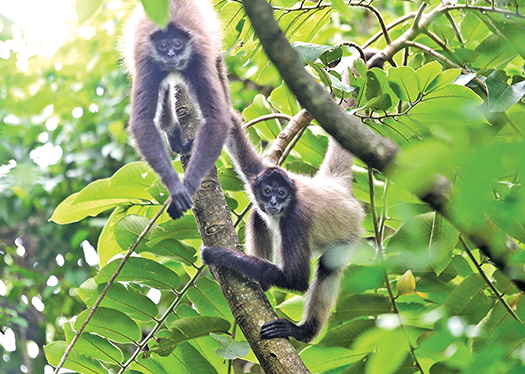
El Salvador’s spider monkeys have struggled amid fragmentation of the country’s forests. (Photo by Jessica Orellana)
High in the canopy of the Chaguantique Natural Protected Area, a small group of black-handed spider monkeys (Ateles geoffroyi) moves among the native trees in search of wild fruit. To an untrained eye, they might appear to be thriving. But in fact, these primates—dubbed the “architects of the forest” for their crucial role in seed dispersal—are struggling against the odds to survive within one of the smallest and most isolated forest fragments in El Salvador.
Chaguantique, a state-run reserve encompassing approximately 54 hectares (133 acres) in the department of Usulután—east of San Salvador—is one of the last vestiges of the primary forest that once blanketed El Salvador’s coastal plains. A protected habitat-management area since 2008, it serves as the primary sanctuary for the spider monkey, the country’s most threatened mammal. Yet a combination of government inaction, regulatory paralysis, and a lack of official transparency threatens to drive this local population to extinction.
The plight of the spider monkey reflects a structural crisis within the National System of Protected Natural Areas (SANP), which oversees reserves encompassing 3.51% of El Salvador’s land area. According to a 2025 study, the country’s protected lands are suffering from a chronic state of neglect.
The study was prepared by Association GAIA El Salvador, a respected Salvadoran environmental group, in collaboration with the Friedrich Ebert Foundation (FES), a foundation associated with Germany’s Social Democratic Party. It found that the Ministry of Environment and Natural Resources (MARN), which oversees the protected-areas system, has not published a national report on the status of the system’s sites for 13 years.
The report also says two crucial environmental laws in effect for 18 and 23 years respectively—the Law on Protected Natural Areas and the Wildlife Conservation Law—lack implementing regulations, rendering enforcement of them impossible.
Meanwhile, the transparency needed to fully understand and address the problem appears to be in short supply. Since 2019, the government has classified public information regarding the legal status, transfer, and titling of protected lands in El Salvador as “restricted,” thereby preventing independent oversight by civil society and the scientific community.
“There’s no point declaring new protected natural areas if we cannot even manage the ones that already exist,” notes biologist Melissa Rodríguez, director of terrestrial systems at Territorios Vivos El Salvador, a nonprofit.
Need for fresh information
The spider monkey population in Chaguantique numbered 29 individuals in 2003 and grew to 50 by 2019, thanks to the initial efforts of MARN’s National Program for the Conservation of the Spider Monkey. However, no official census or population update has been conducted since that time. “We lack basic, up-to-date information,” Rodríguez notes. Referring to Chaguantique and forest fragments elsewhere, she adds: “We simply don’t know how many monkeys are at each site today.”
An underlying problem is MARN’s wildlife-conservation attention has shifted from spider monkeys to species, such as sea turtles and parrots, that draw more attention from international partners. Experts say this has left spider-monkey conservation efforts without support for continuous monitoring. Government officials did not respond to requests for an interview regarding the lack of current data and the shift in conservation priorities.
As large-bodied frugivores—measuring up to 50 centimeters and weighing around 18 pounds—spider monkeys require extensive land area and continuous forest canopies to forage. In Chaguantique, extreme habitat fragmentation forces the primates to live dangerously close to human settlements.
Experts warn that the lack of biological corridors connecting Chaguantique to other small refuges near the Bay of Jiquilisco, El Salvador’s largest coastal estuary and mangrove forest, boosts the risk of wildlife inbreeding and associated genetic and physical decline. And as droughts attributed to climate change intensify, natural food sources in the reserve dwindle.
“In the summer, we have found dead monkeys in the forest,” says Carlos Leiva, a local resident. “We believe it’s because there isn’t enough food, and they end up fighting among themselves. The females’ milk dries up and their offspring die. That is why they sometimes come into people’s yards to steal fruit.”
And when young animals are taken from their habitat by animal traffickers, they lose the ability to develop the vocalizations specific to their species, making their reintegration into the wild nearly impossible.
Collapse of community model
The degradation of Chaguantique also highlights the collapse of community-based conservation initiatives. In the early 2000s, the area hosted an ecotourism project—funded by Spanish development aid—that included an interpretive center where local children received environmental education. That infrastructure now lies in ruins. Residents say the initiative was halted years ago due to gang activity in the area, and state support was never restored.
“I remember we’d be taken from school to the interpretive center for workshops about monkeys, and the community benefited from tourism,” recalls 22-year-old Yajaira López. Her younger sister, Alejandra, notes her own generation lacked that kind of training.
Experts say local extinction of the spider monkey would devastate El Salvador’s remaining coastal forests given their role as the primary dispersers of large seeds. Concentrated attention must be paid both to the monkeys and the forest, they argue. “The long-term survival prospects for the species in the lowlands aren’t very high unless there’s a massive investment in forest connectivity and active protection,” warns Melissa Rodríguez.
Notes Carlos Leiva: “The monkeys are simply reclaiming the space they need to live. Governments may not see it that way, but those of us who live here and share the territory with these animals see it every single day.”
- Jessica Orellana
In the index: Protected-area infrastructure as well as community-based conservation and education initiatives at Chaguantique have succumbed to years of neglect. (Photo by Jessica Orellana)