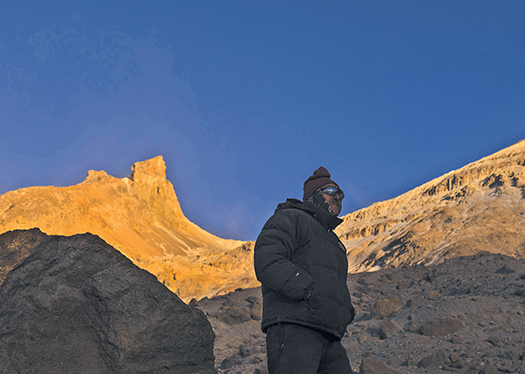
Carlos Zárate shown during a recent visit at dusk to the slopes of the Ampato volcano. (Photo by Denis Mayhua)
Climate change is degrading archeological resources around the world. Heavy rains are causing inland ruins to collapse, rising seas are eroding coastal cultural sites, and melting glaciers are exposing ancient artifacts—and even human bodies, forcing scientists into a race against time to reach them before destructive bacteria do.
In Peru, world-famous for an archeological heritage that includes the Incan citadel of Machu Picchu, the problem is particularly acute. After years of inaction, however, government authorities have begun responding to longstanding calls for a coordinated response. (See related Q&A—this issue.)
On Aug. 28, Peruvian ministers approved a methodological “guide” aimed at “planning disaster risk management influenced by climate change.” According to the country’s Ministry of Culture, the document provides “guidelines, technical criteria, and practical tools” to help Peruvian authorities incorporate climate-change-related risk management into their oversight of Peru’s World Heritage Sites. It marks one of the ministry’s first steps to address the impact of climate change on the country’s cultural heritage.
For experts such as archeologist Rómulo Pari Flores, a professor at the Catholic University of Santa María in Arequipa until his retirement in July this year, the policy is long overdue. Pari Flores says the government has spent decades doing “absolutely nothing” to protect its cultural heritage, even though climate-change-induced damage to cultural sites has been apparent for decades.
A jarring wake-up call occurred in April 2022, with the sudden collapse of large sections of Kuélap, a cloud forest fortress built in approximately A.D. 600 by the pre-Incan Chachapoya civilization. The fortress, located on the eastern slope of the Andes in northern Peru’s Amazonas region, was caught on video as portions of it gave way during a two-day period. Stones the size of soccer balls began falling from its walls onto the grassy slope below. Then entire sections of the perimeter walls gave way, tipping over and sending clouds of gray dust into the air.
Amid national headlines about the damage, Peruvian archeologist Iván Ghezzi was sent north by his institution, the Pontifical Catholic University of Peru in Lima, to determine the cause.
His findings pointed in part to an untimely confluence of circumstances and conditions. “It was the perfect storm,” Ghezzi told the state-run newspaper El Peruano in 2023. “It happened at the weakest point. There were heavy rains. An earthquake had just occurred in the area. [And] the drainage system didn’t work.”
Ultimately, he concluded the prime cause of Kuélap’s dramatic wall collapses was climate change.
Ghezzi, who received a doctorate in anthropology from Yale University and has served as director of Peru’s National Museum of Archeology, Anthropology and History, analyzed satellite imagery covering four decades. His team of researchers, the majority of them foreign scientists, blamed extraordinary rainfall between 2018 and 2022.
“We have gathered robust data showing a progressive increase in rainfall in the area due to climate change,” Ghezzi said recently in an interview with EcoAméricas. “This is clearly the primary cause of the site’s deterioration. Kuélap has survived for centuries in a region of Peru that receives heavy rainfall. However, it is highly likely that climate change has pushed the site beyond its natural capacity to drain rainwater infiltration.”
Local guides had warned as early as 2019 about the risky state of the Kuélap fortress. They submitted documents to the Ministry of Culture showing sections at risk of collapse and asked the head of the agency to declare a state of emergency. No action was taken, they told newspaper La República shortly after the walls fell. In 2004, World Monuments Watch, a monitoring program of the nonprofit World Monuments Fund, had included the ancient walls of Kuélap on its “watch list” to spotlight their fragile state.
Ghezzi is also examining the effects of climate change on the 2,300-year-old solar observatory Chankillo in the coastal desert north of Lima. The astronomical complex covers 400 hectares (990 acres) and contains a fortified temple, administrative areas and thirteen towers that are believed to serve as a calendar. From the sky, the site looks like two large circles drawn in the desert. The complex, declared a World Heritage Site in 2021, consists largely of stone structures. As occurred in Kuélap, its walls are showing increasing signs of cracking and other deterioration.
“At Chankillo, the main reason for the site’s deterioration is the disintegration of the mud mortar binding the stones of the walls,” says Ghezzi. “Rising temperatures and humidity in the coastal desert environment […] increase the daily temperature range, [which is] the difference between the daytime high and the nighttime low. This causes mechanical fatigue in the mortar through cycles of thermal expansion and contraction.”
He also mentions the strong winds in the area. Using a thermal drone and satellite imagery, new discoveries about the role of climate change and extreme weather events in hastening the fortress’s deterioration were made, according to the World Monuments Fund.
Ghezzi believes he is one of only two Peruvian archeologists examining the impacts of climate change on archeology. Worldwide, there are very few people studying this relationship, says one of them—Danish geographer Jørgen Hollesen.
“It’s a very small field,” Hollesen says. “There is a knowledge gap between archeologists and the people studying melting glaciers or rising sea levels.”
Hollesen, a geographer at the Danish National Museum, has published several papers on how cultural heritage is lost or damaged due to the effects of climate change. He classifies impacts in three ways.
“Firstly, heritage is damaged through biological degradation due to temperature rise and an increase of oxygen,” Hollesen says, noting that as ice or permafrost melts, the soil temperature increases and more oxygen is available in the soil for bacteria to use in decomposing organic material or human bodies. “It’s like taking food out of the freezer. The biological activity, the microbes, the bacteria; they’ll all start decomposing the food, and—in the end—you lose it.”
Another category is rising sea levels. “If the seas are rising, you get more erosion, wave activity and storms, which can damage coastal cultural heritage sites,” Hollesen says. Peru has not yet looked into this. And finally, the lack or abundance of precipitation, also caused by climate change. Sites can dry out, impairing the structures. Or, in the case of Kuélap, too much rain can also cause harm, because the earth can no longer naturally drain the rainwater.
Hollesen focuses his research on the Arctic, where the retreat of permafrost and ice is revealing and destroying archeological sites at a rapid pace. “We have to pick and choose which sites we want to study before they degrade,” he says. “You can’t save everything.” His team has now started mapping out what areas of the Arctic are likely to melt when, so they can then choose where they will excavate first.
In Peru, retreating glacier ice and higher temperatures are also exposing cultural heritage sites in the Andes, but scientific investigation and intervention is especially complicated at high elevations. Just over 30 years ago, two climbers were extremely lucky to almost fully preserve what has been termed a “time capsule” from the Incan empire.
On Sept. 8, 1995, Peruvian climber Miguel Zárate and U.S. anthropologist Johan Reinhard summited southern Peru’s 6,290-meter (20,600-foot) Ampato volcano. There, they found several small statues and artifacts and saw a broken stone structure that had spilled its contents into the crater. Following the trail of artifacts, they came across the body of a frozen Inca girl.
At first, it appeared to be a bundle of brown cloth. But when Zárate hacked the bundle from the ice and turned it over, he found himself looking into the face of a girl who lived in Peru 500 years ago. The so-called Ice Maiden had been discovered, a now world-famous mummy attracting tens of thousands of tourists to the Andean Sanctuaries Museum in the Peruvian city of Arequipa every year.
The girl had been sacrificed during the ritual of Capacocha, in which the Incas offered goods or sacrificed humans to their gods, who are the mountains. Some people think they did this to ask for rain, as the rituals were often carried out in harvesting season. The girl on the mountain top was 12 to 14 when she was killed—while heavily sedated—by a blow to the back of her head. She was then buried in the stone structure, where she lay frozen for 500 years.
The reason the climbers found her was that, for the first time, Ampato’s summit was free of snow. This was partly due to climate change: Peru has lost 59% of its glacial surface in the past six decades due to rising temperatures. But more importantly, a nearby volcano had erupted and scattered dark ash on Ampato’s white slopes. The darker color absorbed the sun’s heat rather than reflected it, melting the ice, revealing the mummy’s tomb and weakening its walls, ultimately resulting in the girl falling into the crater.
Her body was completely frozen, except for her face. It had been exposed to the sun and dried out. Miguel Zárate’s brother Carlos, a professional mountain guide, had hiked up Ampato with tourists exactly two years before. He’d found an Inca shoe made from alpaca wool and human hair and a wooden spade at over 6,000 meters altitude. His group didn’t summit due to the physical condition of one of the tourists—at these altitudes, hiking is extremely exhausting because the oxygen levels are half of those at sea level.
He realizes that if he had, he might have found the girl’s tomb intact. After finding the artifacts, he understood there must have been Inca activity, which had been unthinkable because the peaks were always snowy and very hard to climb. Carlos Zárate, now 68, says he traveled to different organizations and ministries asking for money to set up an official expedition to Ampato, but could find no backers. So he went back to his business of guiding tourists through the mountains.
The Zárate brothers claim there are more human-sacrifice sites to be found on the peaks of the Andes, as does Pari Flores, the archeologist. So far, four such sites have been discovered on the volcanoes surrounding Arequipa, and there are many more skeletons of adults found in graves on the mountain tops. The mountains and volcanos were sacred to the Incas. Some of those mountains are still snow-covered, though perhaps not for long.
This year, Peru is bracing for what experts say could be an unusually strong El Niño, the global weather pattern prompted by elevated water temperatures in the central and eastern tropical Pacific Ocean. A study published last year by Peru’s National Institute for Research on Glaciers and Mountain Ecosystems (Inaigem) concludes that El Niño’s more frequent appearances, together with warming of the atmosphere, “account for much of the recent and dramatic reducing of glaciers.”
Experts point out that if the burial sites of other Inca sacrifices are not found in time, bodies offering important perspectives on the past will be lost before their existence is even known. Pari Flores says the Peruvian government must do more to protect its cultural heritage as it works to safeguard the environment.
“The government is waiting for the private sector to invest in our heritage,” he says. “Peru is not interested in these high-altitude sites because they can’t exploit them for tourism. It’s too high to take tourists up there.”
Nor, he argues, is the country properly addressing the damage heavy rainfall is doing to the country’s archeological heritage in the north. The solution for that, he says, is simple: “Build a roof.”
- Noah Moeys
In the index: Ongoing deterioration of the Moray archeological site near Cusco has prompted local community leaders to call on the Peruvian government to fund restoration work. (Photo by Noah Moeys)