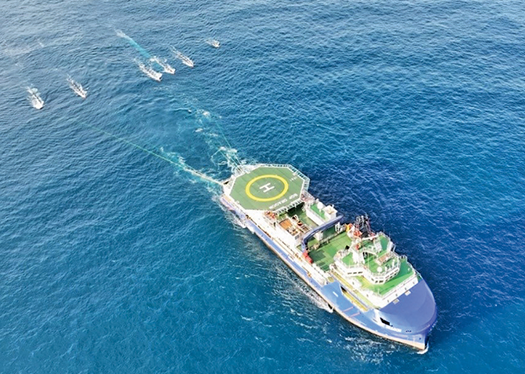
The BGP Prospector tows hydrophones that record air-gun-generated sound waves as they rebound from the sea floor and underlying geological layers. (Photo by BGP Inc.)
A vessel on Feb. 28 began conducting controversial seismic exploration in Uruguayan waters on behalf of Chevron to locate undersea oil and gas reserves.
Such projects involve the use of air guns to send low-frequency sound waves of up to 250 decibels into the seafloor. The extremely loud pulses, emitted multiple times a minute, enable 3D mapping of underlying geological structures. But researchers say they can also potentially injure and even kill marine animals and affect their behavior—for instance by disrupting feeding patterns, altering swim routes of cetaceans, or disrupting the distribution of fish.
Amid concern about the damage it could pose to marine life, the project has drawn strong opposition from environmentalists, academics, and even prompted a prominent member of the Uruguayan Environment Ministry to resign.
But the head of the ministry, Edgardo Ortuño, approved an environmental management plan for the exploration on Feb. 27. The environment minister also authorized the planned navigational route of the vessel, the BGP Prospector, and recommended financial compensation to offset losses that might be sustained by the fishing industry.
The 100-meter-long (330-foot) BGP Prospector arrived at the port of Montevideo on Feb. 2 from Guyana. Then, on Feb. 26, it sailed out to await the project ‘s approval in the exploration zone, an area of 14,500 square kilometers (5,598 square miles), from 50 to 100 kilometers (30 to 60 miles) off the coast.
The ship, operated by CGG Services, a company contracted by U.S.-based energy giant Chevron for the work, is authorized to conduct seismic exploration during the months of March and April.
Chevron is the first of five oil companies to acquire oil and gas exploration rights from Ancap, Uruguay’s state-owned oil monopoly. The other four companies are in different states of preparation for exploration in 2026 and 2027 in a delimited area of Uruguay’s Exclusive Economic Zone (EEZ). The EEZ begins at the outer limit of the country’s 12-nautical-mile-wide band of territorial waters and extends 200 nautical miles (370 kilometers) further offshore.
Though Uruguay has allowed offshore oil exploration as far back as 1976, oil and gas reserves have not been discovered in commercial quantities.
Biodiversity official resigns
Controversy over the most recent exploration plan intensified in December 2025, when the environment ministry authorized four companies to seek offshore hydrocarbon-exploration approvals. It led to the Feb. 13, 2026, resignation of Estela Delgado, the environment ministry’s national director of biodiversity and ecosystem services, due to disagreement over the government’s plans.
“Oil extraction has a significant environmental impact, and we must assess whether we are willing to bear those costs,” she said after her resignation. She added her concerns had been heard by the government and that many of her mitigation suggestions had been incorporated in the environmental management plan.
Delgado has been succeeded by Verónica Piñeiro, former head of environmental management for the municipality of Montevideo and an ally of the governing Broad Front political party.
A key complication for offshore oil-development plans is a surge in interest among Uruguayans in the rich marine life inhabiting the country’s waters. That environmental consciousness was deepened in large part by an unprecedented scientific and public-outreach project in 2025. Funded by the Schmidt Ocean Institute, Uruguayan and international researchers partnered to investigate the seafloor off Uruguay and broadcast its rich array of marine creatures on live television and online.
The broadcasts occurred from Aug. 22 to Sept. 19, with two-a-day airings on public television as well as live streaming on YouTube that received up to 150,000 views.
Viewers embraced “stars” including endearing octopuses and the elusive, deep-diving ocean sunfish (Mola mola), which is believed to be the world’s heaviest bony fish, weighing up to 5,000 pounds (2,270 kilograms). Viewers also saw live images of brilliantly colored corals, prompting widespread comment about how the country’s terrestrial life seemed drab by comparison.
Consistency versus discovery
In opposing offshore hydrocarbon exploration, green groups highlight the activity’s inconsistency with Uruguay’s widely praised embrace of renewable power, which now accounts for 98% of the country’s electricity.
In a December statement, the Uruguayan affiliate of Friends of the Earth warned seismic exploration would cause “severe socio-environmental impacts affecting marine flora and fauna, fishing, tourism, among other things.” The project, the international nonprofit went on to say, “reveals a huge contradiction with the country’s intentions to advance toward new phases of the energy transition based on renewable energy.”
Opponents also argue the exploration violates the national constitution and Uruguayan environmental laws. Meanwhile, the Uruguayan National Human Rights Institution and Ombudsman (INDHH) has weighed in. The autonomous, state-funded agency filed a court injunction in February seeking to block the seismic exploration, arguing that the activity’s extreme acoustic impacts threaten biodiversity and the rights of those engaged in the region’s fishing industry.
The government, for its part, has underscored that exploration is one step and production quite another.
Said Environment Minister Ortuño in December: “We’re simply enabling access to information about our resources to determine whether or not we have hydrocarbons. If this is confirmed, a period of national dialogue will follow to collectively decide whether Uruguay will exploit these resources, but that stage will come much farther in the future.”
- Javier Lyonnet
In the index: This image of a sea sponge was among many broadcast live to Uruguayans in a seafloor research and public-awareness project. (Courtesy of Schmidt Ocean Institute)