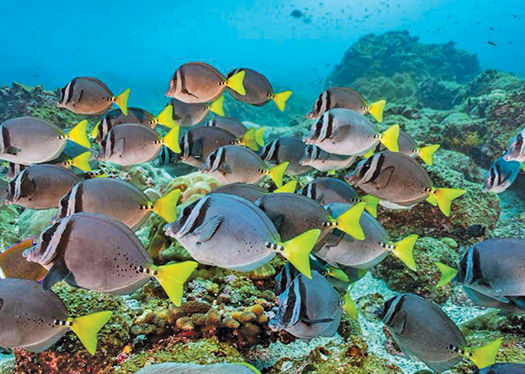
As scientists learn more about the connections between undersea habitat in the eastern tropical Pacific, conservationists are pushing for transboundary protection of marine waters. (Photos by Max Bello, Blue Marine Foundation)
Efforts to protect migratory swimways that extend from one country’s waters to another’s have stirred growing interest in recent years, as global warming pushes ocean temperatures up and joins water pollution and overfishing to drive marine biodiversity down. In the eastern tropical Pacific, one such initiative has received particular attention—the creation of contiguous deepwater reserves to safeguard species that move between earlier-established marine-conservation areas around Ecuador’s Galápagos Islands and Costa Rica’s Cocos Island.
The two new reserves—Costa Rica’s Bicentenario Marine Management Area, created in 2021, and Ecuador’s Hermandad Marine Reserve, established in 2022—occupy adjacent portions of their respective countries’ exclusive economic zones (EEZ). In an EEZ, which extends 200 miles beyond baseline territorial waters, a nation has exclusive rights to natural resources, though other countries have the right to navigate or overfly the area.
The connecting reserves cover part of a migratory swimway in order to create a protected corridor between the species-rich waters of Cocos Island National Park and those of the Galápagos Marine Reserve surrounding Galápagos National Park. Scientists say the swimway is used as a migratory route by endangered sea animals including the hammerhead shark (Sphyrna lewini), the silky shark (Carcharhinus falciformis), the bigeye thresher shark (Alopias superciliosus), the leatherback sea turtle (Dermochelys coriacea) and the giant oceanic manta ray (Mobula birostris).
When scientists conducted an expedition to Hermandad in 2024, they expected to see migratory movement through the area. But they didn’t think that the remote reserve—which lies beyond the 40-nautical-mile-wide band of the Galápagos Marine Reserve ringing Galápagos National Park—would contain the wide range of marine life they found. “[The expedition] shows Hermandad has diverse and abundant biota, and confirms the corridor’s role as a migration zone for pelagic species,” says Christian Sevilla, ecosystems director at Galápagos National Park.
During the expedition, scientists recorded the presence of a Risso’s dolphin (Grampus griseus) and several species of threatened sharks. The sighting of the dolphin was particularly noteworthy; although abundant in Costa Rican waters, Risso’s dolphins are rarely seen in the Galápagos. In all, the expedition documented some 200 marine species in Hermandad’s waters.
“This is a remarkable number for an area designed as a corridor,” says marine biologist Alex Hearn, a professor at the University of San Francisco de Quito and a member of the expedition team.
The Hermandad, or “Brotherhood,” Reserve spans 60,000 square kilometers (23,000 sq. miles), adding to the 143,000 square kilometers (55,000 sq. miles) of the Galápagos Marine Reserve (GMR), which surrounds the islands of the Ecuadorian archipelago. Pressure to improve marine conservation off the Galápagos intensified in 2017, when a Chinese-flagged ship, Fu Yuan Yu Leng 999, was detained inside the GMR carrying more than 7,600 mutilated sharks. (See "Chinese vessel’s hold is portal to sharks’ plight" —EcoAméricas, August 2021.) The carcasses belonged to 12 different species of sharks, whose fins command high prices in east and south Asian markets, where they are prized delicacies.
The massacre prompted local organizations—along with then-President Lenín Moreno—to pledge to expand protected waters in the area, a commitment realized in 2022 under the administration of Guillermo Lasso with the establishment of Hermandad. (See "Outbound Boric earmarks salt flats for protection" —EcoAméricas, February 2026.)
The new reserve was designed through a multi-stakeholder consensus-building process that included representatives of the industrial fishing sector. The approach drew praise from many experts—among them Hearn, who describes it as an example of good governance. And it appears to have borne fruit, according to a study on compliance with industrial-fishing restrictions in the reserve published in March in the journal Marine Policy.
The study found that in the four years since the reserve was established, industrial fishing around the Galápagos—primarily targeting tuna species such as skipjack (Katsuwonus pelamis), bigeye (Thunnus obesus), and yellowfin (Thunnus albacares)—declined significantly, even before the formal enforcement of control measures had begun. Those control measures include use of patrol vessels and satellite monitoring.
Experts say the finding underscores the importance of marine corridors as critical routes for migratory species and as zones for fisheries regulation. It also illustrates how involving stakeholders in conservation can benefit enforcement. In Hermandad, that enforcement involves overseeing a 30,000 square-kilometer “no take” zone and a same-sized area in which regulated fishing is allowed.
“This unprecedented compliance with a new marine protected area points to the potential importance of a consensus-building approach among scientists, government officials, and fishers,” the Marine Policy study highlights.
The positive result has encouraged proponents of further expansion of Hermandad. In particular, they want to include the Paramount seamount, which occupies Ecuadorian EEZ waters roughly 230 kilometers (120 nautical miles) northeast of the Galápagos and rises to within 190 meters of the ocean’s surface. Paramount is located within a portion of the Galápagos-Cocos migratory corridor that was not included in the Hermandad Reserve.
For marine biologist Marta Cambra, who has participated in several scientific expeditions in Galápagos waters, the seamount should have been part of the reserve from the start.
“No other site has been found that offers stronger evidence of its ecological importance,” she says. “It is quite possibly the most significant site requiring protection. If we do not protect Paramount, we would not truly be protecting the migratory corridor.”
Expeditions in the area of the seamount have documented an abundance of hammerhead, thresher, and silky sharks. Researchers say sharks and other species use the seamount as a resting and feeding “stepping stone” along their migratory routes. During one expedition, a school of hundreds of hammerhead sharks was captured on video, underscoring the site’s importance in this respect. If a seamount goes unprotected, it becomes vulnerable to the lucrative shark-fishing trade, warns Maximiliano Bello, a global specialist in marine protected areas at the London-based Blue Marine Foundation.
The Galápagos archipelago is recognized as a marine biodiversity hotspot, and experts believe Paramount might be, too. They say the seamount likely functions as a migratory way station in particular between Costa Rica’s Cocos Island and Colombia’s Malpelo Island, which lies well outside the Costa Rican-Ecuadorian marine conservation corridor.
Sevilla, the Galápagos National Park ecosystems director, tells EcoAméricas that if scientific evidence confirms Paramount is indeed a biodiversity hotspot, it could potentially be incorporated into the Hermandad Marine Reserve.
“It is a very important area—one that possibly holds an even greater concentration of sharks than Darwin and Wolf [Islands], the most significant areas in the Galápagos,” Sevilla says. “What we do not yet know is whether these sharks—particularly hammerheads—remain in this area, as they do at Darwin and Wolf, or if it serves merely as a transit point. The primary objective regarding hotspots and protected areas is to determine their interconnectivity and migration corridors, and to ensure that protection measures are effective. It is not only the hotspots themselves that require conservation, but also the areas connecting them, as these zones harbor immense biodiversity and serve as major migration routes for various species.”
The islands of Darwin and Wolf—the northernmost islands of the Galápagos archipelago—host the largest shark biomass on the planet, particularly hammerheads, and serve as a unique sanctuary for threatened species, according to research by the Charles Darwin Foundation.
Two new scientific expeditions—one currently underway and another scheduled for September if weather permits—form part of a biennial research program led by Galápagos National Park. They are expected to provide greater clarity regarding the role of the Paramount site.
While much marine-conservation attention in Ecuador is focused on Paramount, in Costa Rica concerns are growing that longline fishing may be permitted within the Bicentenario, or “Bicentenary” Marine Management Area (AMMB). This type of fishing, which Ecuador does not allow in Hermandad, is considered highly damaging on account of its indiscriminate nature. It often involves setting out miles-long lines with thousands of baited hooks that not only ensnare targeted fish species, but also other animals including sharks, sea turtles and even seabirds.
In December 2021, Costa Rica expanded Cocos Island National Park from 2,034 square kilometers (785 sq. miles) to 54,844 square kilometers (21,175 sq. miles) and Bicentenario Marine Management Area was created, adding 106,285 square kilometers (41,000 sq. miles) to serve as a complementary management zone, albeit with a lower level of restrictions than the park’s waters.
Although the park and Bicentenario are touted as a model of marine conservation, experts point out that the waters lack effective regulations and oversight to safeguard vulnerable species. Scientists and conservationists are pushing for more rigorous fisheries management of Bicentenario’s waters. Costa Rican conservationist Randall Arauz points out that despite the expansion of the park’s protected waters, the management plan approved for the area in 2025 for Bicentenario classifies longline fishing—considered a major contributor to the steep decline of shark populations worldwide—as a form of sustainable fishing.
Follow-through questioned
“It’s a custom of the [Costa Rican] Ministry of Environment and Energy to celebrate the designation of marine management areas as a conservation achievement, yet it fails to approve a [specific] management plan,” Arauz says. “This occurred in 2011 with the creation of the Seamounts Marine Management Area. Now, with the Bicentenario Marine Management Area, history seems to be repeating itself. It is claimed that it protects 30% [of the EEZ], but in reality, fishing remains unregulated.”
When Bicentenario was created in 2021, it was supposed to have a management plan in place within two years of its expansion. However, legal challenges filed by fishermen and fishing industry associations delayed release of the plan. It was not until October 2025 that the new reserve’s General Management Plan (2025–2035) was finally approved. Specific regulations are still pending.
The approved general management plan has drawn objections for identifying longline fishermen as the most representative user group. To the dismay of conservationists and many scientists, the plan also describes commercial longline fishing as sustainable.
Specific regulations are to be defined in a more detailed Fisheries Management Plan, which, by court order, must enter into force this year. Scientists anticipate longline fishing will be permitted, given that representatives of that economic sector have regularly attended meeting on development of the blueprint.
According to the zoning scheme outlined in the general management plan, an absolute protection zone applies within a two-nautical-mile radius of seamounts but only at depths of 500 meters or more.
“There is no such thing as sustainable longline fishing,” Arauz argues. “They may propose using fewer hooks, but they will still catch hammerhead sharks. Allowing the use of circle hooks [which catch in the jaw area rather than in the stomach or throat] will also result in the capture of sharks and other species.”
Longline concerns
If longlining is indeed approved under the detailed management plan, Costa Rica’s major challenge will be to demonstrate it won’t cause a high rate of “bycatch” of non-targeted species—and as a means to deliberately target shark for their valuable fins. Though restrictions on shark fishing exist in both Costa Rica and Ecuador, illegal taking and trade of their fins continues in both countries.
Fins are typically exported to Hong Kong and distributed from there elsewhere in east and south Asia, while shark meat is marketed primarily within Latin America, much of it in Mexico and Guatemala. Prices vary by species and size: hammerhead shark fins exceeding six inches can fetch between $100 and $150 per kilo at the docks; silky shark fins, between $40 and $50; and the smallest fins—known as “chips” or “picaritas”—sell for $10 per kilo. In Asia, a single bowl of shark fin soup can exceed $100. Although shark meat fetches only $0.50 to $1 per kilo, the sheer volume traded makes it a significant revenue-earner as well.
Under the 2022 Kunming-Montreal Global Biodiversity Framework, participating countries agreed to a “30x30” goal of conserving 30% of their land and waters by 2030. For Hearn and other experts, Bicentenario’s fishing restrictions should not qualify the reserve to count as conserved.
“Banning hook-and-line fishing at depths greater than 500 meters seems like a symbolic gesture,” he says. “Hammerhead sharks, turtles, and birds do not inhabit those depths. It would not be very fair to include Bicentenario as part of that 30%.”
- Mercedes Alvaro
In the index: In a 2024 expedition to Hermandad, scientists gauged the range of marine life in the new reserve. (Photo Joshua Vela/DPNG-DUSFQ-OFC)