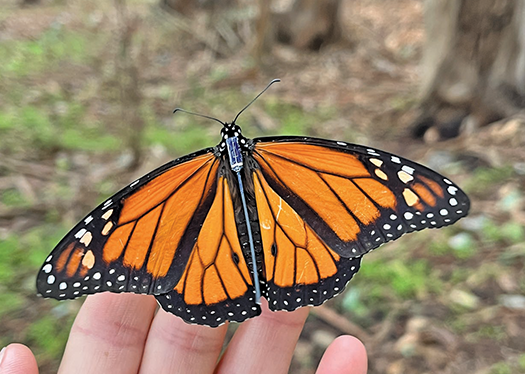
Monarch outfitted with tracking tag is released in Santa Cruz, California, in Nov. 2025. (Photo by Elena Oey, Point Blue)
The number of monarch butterflies (Danaus plexippus) that spent the winter of 2025-26 in the mountain forests of Central Mexico rose for the second consecutive year, a recovery experts attribute to favorable, wetter weather during the insects’ spring and fall migrations.
The butterflies clung to oyamel fir (Abies religiosa) trees covering some 7.24 acres (2.9 hectares) in nine locations in the states of México and Michoacán, according to data published March 17 by the World Wildlife Fund and the Mexican government. That’s a 64% increase over the winter of 2024-25, when monarchs, famous for their mystifying multigenerational migration, covered 4.4 acres (1.8 hectares).
The fact the butterfly population did not shrink was “a good sign that we’re holding our own,” says Karen Oberhauser, a professor emerita at the University of Wisconsin-Madison who has studied monarchs for decades.
Oberhauser says a long drought in Texas abated in the spring 2025, so insects flying north after hibernating in Mexico had nectar to eat and milkweed on which to lay eggs. A wet spring in the northern United States and Canada meant the butterflies arriving there also had food and breeding habitat. As a result, the population that set off towards Mexico in the fall was quite robust, says Oberhauser.
Still, the uptick does not mean long-term threats to monarchs have abated, say scientists. These include loss of grassland and higher pesticide and herbicide use in the U.S., and destruction of winter habitat in Mexico and California.
Case of California
The butterfly’s fragility was evident last winter in California, where a separate and much smaller population of monarchs roosts after migrating from plains west of the Rocky Mountains. Just 12,260 of those monarchs were counted by community scientists and conservationists at nearly 250 Californian hibernation sites. This was a 34% increase from the year before, but still among the smallest populations ever recorded.
Scott Black, executive director of the Xerces Society for Invertebrate Conservation, a Portland, Oregon-based nonprofit, says the number of monarchs in the West is so small that it would take only one disaster to wipe them out.
“We may be at a tipping point,” he says.
While the picture for monarchs remains bleak, their behavior has become clearer. Last year, scientists for the first time attached tiny, solar-powered Bluetooth tags to some 400 butterflies, tracking individual journeys from Canada and several U.S. locations to the Mexican hills and, in fewer cases, within California. A further 172 tagged at overwintering sites in Mexico are now being monitored as they fly north.
The tags emit electromagnetic pulses that are picked up by mobile phones, allowing scientists to follow an insect’s entire trajectory. Flight data is compiled by the devices’ New Jersey-based maker, Cellular Tracking Technologies. It is fed to scientists who pay a small fee and, in lesser detail, is published on a free app called Project Monarch Science. The technology is “game changing,” says Ray Moranz, a pollinator conservation specialist at Xerces. “We are learning so much.” Data from this year’s migration has revealed where butterflies go, how fast they fly, how they respond to wind and how often they switch between winter roosting sites, Moranz and other scientists say.
Unexpected directions
The information, still preliminary, has not been properly analyzed; but scientists say some of the individual butterfly routes have been eye-opening. Butterflies tagged in New Jersey and Pennsylvania, for example, flew to Florida for the winter, rather than to Mexico—alerting conservationists to the need for more pollinating plants in Florida, says Moranz.
Meanwhile, monarchs hibernating in California moved often between colonies as well as around and within the city of Santa Cruz, says Ashley Fisher, a conservation biologist with Xerces. This underscores the need to conserve as many hibernation spots as possible, she says, as well as to make sure there are pollinating plants available.
Moranz was struck by the degree to which wind dictated the pace and direction of flight. A group of butterflies that were fitted with transmitters on the north shore of Lake Eerie in Canada flew hundreds of miles to Kentucky within a few days, borne by the wind, he says. But there they met headwinds coming from the south, so they glided westward to central Oklahoma.
Conservationists cannot change the winds, says Moranz, but they can promote wildflower planting to ensure there are flowers in bloom for monarchs who get pushed off course and need extra sustenance.
The data also gave a sense of the butterflies’ survival rate. Of the 20 monarchs Moranz tagged, 14 made it across the Rio Grande to Mexico, half of those reached the overwintering colonies, four survived the winter and two made it back to the United States in the spring.
One of these insects—tagged by Moranz in Oklahoma last fall and labeled XSTI009 on Project Monarch Science—was in Georgia, near the Florida border, on its way back north as of March 27. Moranz, who was heading to Florida then, wondered if they would be reunited.
- Victoria Burnett