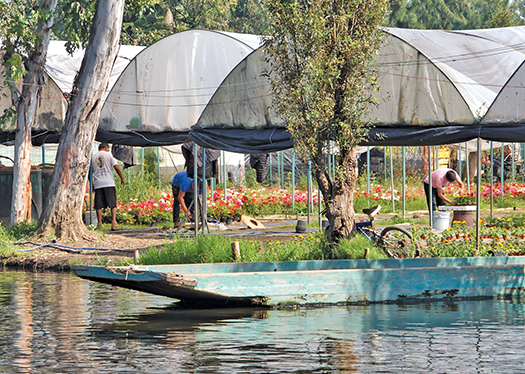
Green advocates say that unless action is taken, Xochimilco’s shrinking network of waterways and lacustrine farming plots could disappear. (Photo by Angela Perryman/Shutterstock)
Seeds are planted for a new effort to protect Mexico City’s Xochimilco agricultural wetland system and the axolotl (Ambystoma mexicanum), the iconic aquatic salamander endemic to the area’s freshwater channels.
The Xochimilco conservation initiative got a push earlier this year during the March 20-23 International Summit for Life and Peace. Held in Xochimilco, the event drew 170 participants from Colombia, Argentina, Germany, Chile, Mexico, and the United States for discussions on how to reverse the ecological and socioeconomic degradation of the famous Unesco-listed wetland network. The meeting was held by the Planetary Alliance for Sanctuaries of Life and Peace, a Chiapas-based nonprofit that promotes environmentally sustainable communities.
Xochimilco has been the focus of numerous conservation efforts over the decades. It is prized for its canal system and “floating gardens”—the remnants of ancient farming islands, called chinampas, built by the Aztecs.
On paper, the ancient wetland system is subject to eight resource-protection frameworks, Unesco and the Ramsar Convention on Wetlands among them. But critics say these have had little conservation effect due to a chronic lack of enforcement. Xochimilco’s waterways once spanned 170 square kilometers (66 square miles). Encroaching development has reduced them to some 20 square kilometers (8 sq. miles) today.
“We are calling on the [federal-government] anti-corruption system to start a special unit dedicated to anticorruption in nature and we are proposing Xochimilco be the pilot case for the country,” says Luis Alberto Jiménez, an environmental activist and summit organizer. “Mexico already has the environmental laws. What it’s missing is the enforcement. We want to see people being sanctioned for polluting the water, building illegally on the agricultural land and other crimes that today go unpunished.”
Summit attendees included traditional farmers, Indigenous elders, scientists, policymakers and more, the goal being holistic solutions rather than piecemeal approaches. They focused on three challenges: restoration of the chinampa agroecological system as a climate-resilient food production model; legal and governance steps to aid protection of Xochimilco’s water systems and communal land rights; and strategies to address pollution, urban encroachment and biodiversity loss.
Xochimilco, located 15 to 18 miles (24 to 30 kilometers) from the historic center of Mexico City, provides essential environmental services for the capital and the wider Valley of Mexico. These include groundwater recharge, natural water filtration, temperature regulation, flood mitigation, and carbon sequestration. It also helps underpin local food systems and holds cultural value. Conference members declared the area a “Sanctuary for Life and Peace,” saying “cultural, ecological, and food security of millions of people depend on this ecosystem, which today faces a critical threat.”
Rights of nature
Their aim is to initiate a community-led push that by 2030 will secure legal “rights of nature” for Xochimilco and its axolotl, a critically endangered, microendemic amphibian that is ostensibly protected under Mexican law. To prevail, organizers must gather the signatures of 0.13% of Mexico City voters in support of the proposal and find a lawmaker to successfully sponsor it as legislation in the Mexican Congress. The Planetary Alliance for Sanctuaries of Life and Peace is pursuing a similar initiative in Bacalar, the municipal seat of Quintana Roo state. In that case, the group is seeking protection of living, rock-like fossil reefs, called stromatolites, in an enormous freshwater lake near the border of Belize known as Lake Bacalar, or Lagoon of Seven Colors.
“Species in danger of extinction are ... protected because of services they provide humans,” says Patricia Espinosa, an environmental engineer and environmental-law instructor at Earth and Life University in Playa del Carmen, Quintana Roo. “This is an anthropocentric vision. But when a species is recognized to have its own legal rights, the state’s obligations change.”
Experts consider the axolotl a bioindicator of the ecological health of the wetland area, with its population decline linked to local habitat loss, water contamination and invasive species. Mexico City has included the axolotl among the images it has used in promoting the 2026 World Cup, a move Espinosa and others criticize on grounds it devalues the conservation objective. “While the axolotl is dying along with its habitat, others are profiting from the image,” Espinosa says. “The income from this symbol should really be contributing to the conservation efforts so urgently needed.”
Multiple recommendations
The summit statement calls for steps including improvement of water quality and environmental flows; creation of refuges and ecological corridors; captive breeding, reintroduction and scientific monitoring of the axolotl; and integration of conservation with community-based management and education. It also advocates control of invasive species, such as tilapia (Oreochromis niloticus) and carp (Cyprinus carpio), which feed on axolotl eggs and disturb habitat. Results of a 2024-2025 axolotl census are expected in the coming months, but the International Union for the Conservation of Nature (IUCN) estimates fewer than 1,000 of the salamanders inhabit Xochimilco waters.
While the summit included traditional ceremonies with spiritual leaders and offerings to local deities, its official statement also provided a proposed framework for conservation actions along with timelines and accountability mechanisms. The actions included canal rehabilitation, wastewater control, reducing agrochemical use and recovery of chinampas, as well as involvement of communities, scientists and authorities in a governance process.
Conferees argue Xochimilco represents something rare: intensive, low-impact agriculture in an urban environment. The model, they say, offers transferable lessons for wetland conservation, food security and climate adaptation.
“If we lose the lacustrine farming system of Xochimilco, the world will lose its most productive agricultural system,” says Jiménez. “If 100% of Xochimilco’s islands were used for agriculture, they could provide 60% of the capital’s food, yet only about 1% are currently farmed in the traditional way. If the trend is not reversed, Unesco predicts the world will lose this ingenious tradition within two generations.”
- Lara Rodríguez
In the index: The axolotl, endemic to Xochimilco, is viewed as a bioindicator of the area’s struggling lacustrine and wetland ecosystem. (Photo by Henne Damke/Shutterstock)