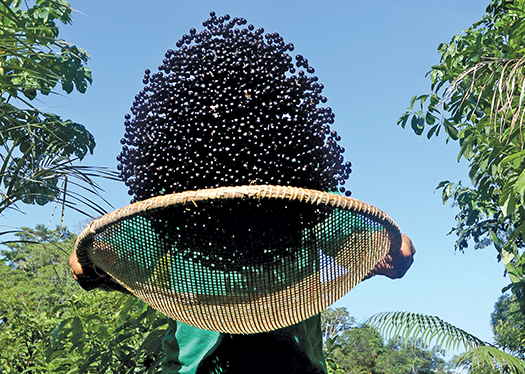
A rural extractivist community member in the Amazonas state municipality of Carauari uses a sieve to clean recently harvested berry fruit of the acaí palm. (Photo courtesy of Ricardo Oliveira/Tyba)
Brazil has unveiled a National Bioeconomy Development Plan (PNDBio) aimed at making sustainable use of the country’s ample biodiversity a major focus of economic development by 2035.
The launch has raised some fundamental questions, however. Among them: What activities, exactly, constitute a bioeconomy? Also, how will the sustainable use of resources be defined and monitored?
The plan, launched on April 1, calls for government loans, price subsidies and other support to promote output of value-added products ranging from biofuels and foods to plant-based medicine and cosmetics. Particularly high on the priority list are products whose sustainable processing can give Amazon communities a strong economic stake in forest protection.
“We can create a new paradigm for sustainable development in the Amazon by harnessing biological assets of the forest—its fruits, nuts, fibers, saps and resins—to improve biotechnologies and turn out value-added Amazon-forest products, be they foods or medicines, and expand markets here and abroad,” said Brazilian climatologist and earth-system scientist Carlos Nobre.
As an example of strong but largely untapped potential on that score, Nobre points to açaí. A berry that grows on palm trees of the same name, the versatile açaí has become popular as a healthy food ingredient across Brazil and abroad partly due to its antioxidant qualities.
“The Brazilian Amazon almost always exports açaí in berry form to markets in the United States, Europe and [into the domestic market in] Brazil, but 80% of the profits from the açaí berry come from processing it into pulp, almost all of which is done by companies in the [foreign] countries and in the [non-Amazon] Brazilian states that import it,” Nobre says. “If Brazil could invest in the biotechnologies to process açaí berries in the Amazon and export the processed pulp, it would create a far more robust income base for the Amazon communities that now pick and gather those berries.”
The bioeconomy plan unveiled in April comprises three sets of goals to be undertaken simultaneously for completion by 2035.
The first set aims to dramatically expand green friendly economic opportunities for low-income family farmers, Indigenous groups and other rural people. This would be pursued by various means, one of which would be to expand government payments to small-farming, Indigenous and traditional communities that provide “environmental services” such as forest and watershed protection. Minimum prices for “socio-biodiversity” products like tropical fruits, nuts, plant oils and tree resins would also be increased.
The plan also calls for establishing contracts with Indigenous and traditional communities on the sharing and commercialization of genetic knowledge based on rainforest plant, animal and microorganism resources. In addition, it aims to rehabilitate degraded pastureland for future small-scale cultivation and make large tracts of federal land available for ecotourism and green-forestry concessions compatible with woodland regeneration.
The plan’s second set of goals seeks to boost bio-industry by using native plant varieties and other genetic resources to develop new herbal medicines for Brazil’s public-health system. Such value-added products could be based on already-exploited Amazon medicinal plants such as Uncaria tomentosa—a thorny vine known in Brazil as “unha-do-gato” and internationally as cat’s claw—and Mikania glomerata, a vine known worldwide as guaco. (See accompanying list of some of these natural ingredients in plant-based products.) And the third set of goals promotes biomass production, partly by developing new bio-technological processes to enable the conversion of biomass—sugarcane waste, wood waste and animal waste, for instance—into biofuels as well as non-energy products that add value.
Brazilian officials estimate the bioeconomy accounts for 25% of the country’s R$12.7 trillion (US$2.2 trillion) economy. And they forecast that PNDBio economic incentives could generate up to US$284 billion annually in additional value by 2050, according to the Ministry of Development, Industry and Commerce (MDIC). Experts note, however, that while the new plan sets broad strategy, it has yet to address key definitional, regulatory and financial details.
“The PNDBio is a positive and wide-ranging plan, which covers everything from agricultural to bio-technological advances,” says Vinicius Oliveira da Silva, a public policy specialist at the Institute of Energy and the Environment (Iema), a São Paulo-based nonprofit energy think tank. “But the government needs to more specifically define what activities comprise the country’s bioeconomy, something that is not done in the PNDBio, and draft public policies to support and regulate them, as well as provide robust and long-term financing to implement these policies, which is an ambitious undertaking.”
Experts generally consider the bioeconomy to comprise activities that result in natural-resource-based products ranging from biofuels and medicines to textiles, tires, and renewable energy. The food and biofuels categories are assumed to include crops such as sugarcane and soybeans—products Brazil leads the world in producing and exporting—and the vast quantities of sugarcane- and corn-based ethanol and vegetable-based biodiesel Brazil makes from soybeans and other crops.
Livestock production also looms large in informal definitions of the bioeconomy. For instance, Brazil’s world-leading beef output and exports are rooted in the extensive use of natural grasses and grains as cattle feed.
Experts say PNDBio must eventually define the components of the bioeconomy and create the policies and regulations needed to monitor and ensure its environmental sustainability. This can be a fraught topic, particularly when it comes to agrochemical-intensive monocrop soy cultivation and the ranching industry, which has been associated with deforestation.
Yet some analysts—IEMA’s Oliveira da Silva among them—point out that the PNDBio does help prepare the way for this important groundwork.
“The absence of a detailed operational definition of what constitutes an environmentally sustainable product is a limitation of the PNDBio, but it does not mean that the plan is devoid of references or sustainability parameters,” Oliveira da Silva says. “The document establishes, in a transversal way, that bioeconomy actions must be aligned with the environmental, climate, and social commitments assumed by the Brazilian state, incorporating concepts such as biodiversity conservation, environmental regeneration, productive restoration, traceability, certification, recovery of degraded areas, respect for the rights of Indigenous peoples and traditional communities, and reduction of greenhouse gas emissions. In addition, various strategic actions foresee mechanisms for certification, life cycle assessment, biomass traceability, emissions monitoring, and environmental compliance, demonstrating that sustainability is present as a structuring principle of the plan.”
Adds Oliveira da Silva: “The plan presents a strategic and guiding vision, but still lacks normative and methodological instruments that allow its principles to be transformed into verifiable and comparable metrics. This challenge does not invalidate the plan nor compromise its central objectives, but it indicates an important agenda for the next stages of implementation, especially in the development of indicators, certification systems, eligibility criteria, and monitoring mechanisms that ensure greater clarity regarding which activities can actually be considered sustainable within the national bioeconomy strategy ... From this perspective, crops such as soy, corn, and sugarcane are not necessarily excluded from the bioeconomy, but their compatibility with the objectives of PNDBio depends on the conditions under which they are produced, the associated environmental impacts, and compliance with the socio-environmental safeguards provided for by the plan.”
Implementation of PNDBio will be overseen by the National Bioeconomy Commission (CNBio), a governance body created for the purpose in 2024. The 34-member commission comprises 17 officials from a variety of government agencies and 17 representatives of the private sector, civil society and academia. It is supported by the Technical Chamber for Monitoring and Bioeconomy Intelligence (CTMIB), which was created to carry out that role under the auspices of Brazil’s Ministry of Science, Technology and Innovation (MCTI).
The PNDBio plan’s progress will be tracked using a theory of change model that addresses environmental, social and economic factors. A performance- and sustainability-monitoring system and related infrastructure will be built and operated by the National Bioeconomy Information and Knowledge System (SNICBio), established in 2025.
PNDBio is slated to receive initial financing of R$357 million (US$69 million) from the Amazon Fund, the US$1 billion rainforest-protection mechanism built largely with contributions from foreign governments and managed by Brazil’s Development Bank (BNDES). The fund has committed R$1.6 billion (US$350 million) towards bioeconomy-related projects in the Amazon since its inception in 2008.
Support is also coming from a public-private sustainable-development investment initiative, Eco Invest Brasil. Created under a 2024 law, the program uses a blended-finance approach in which Brazil’s National Treasury lends money to banks at an annual interest rate of 1%. The banks must mobilize at least four times that amount in private sustainable-development investment, with at least 60% required to come from international sources.
So far, a total of R$140 billion (US$28 billion) in combined public and private resources have been pledged under Eco Invest Brazil, some of it for PNDBio projects. In May, the government said it is committing R$3.1 billion (US$617.5 million) and that eight banks had pledged another $R10.1 billion (US$2 billion) for bioeconomic investment in the Amazon region under the Eco Invest Brasil initiative.
Nobre agrees with Oliveira da Silva about the need for a robust, long-term strategy to finance the PNDBio. “The government’s R$357 million [US$69 million] in initial financing was just seed capital needed to get the PNDBio off the ground, but it is a good start,” Nobre says. “The Eco Invest Brasil program financing commitments announced in May to fund PNDBio with an additional US$2.617 billion is essential for developing and accelerating PNDBio.”
Appraising the plan overall, Nobre says: “The PNDBio is full of good initiatives, especially those that target low-income-based family farmers [and] extractivist, traditional and Indigenous communities. Even though these peoples account for a very small share of the 25% of GDP that Brazil generates with its bioeconomy, they are among those most in need of federal assistance and protection.”
He adds: “It’s also good that PNDBio initiatives don’t include incentives or initiatives that would expand the agricultural frontier in a way that would fuel more deforestation. It’s important that Brazil sustainably increase its bioeconomy via low-carbon agriculture, that which produces more crops on existing land, including that which has been degraded.”
Value-added conservation
One aim of Brazil’s bioeconomic strategy is to ensure that more value-added processing of plant-based ingredients used in natural products occurs in rural regions where those inputs originate. Promoters say this will boost local communities of the Amazon and other biomes, creating incentives for them to safeguard natural resources. Some examples of these ingredients:
Cupuaçu—Aromatic “superfruit” from the Theobroma grandiflorum tree is used in foods and cosmetics, and said to confer immunological, anti-inflammatory and cardiovascular benefits.
Buriti—Fruit from the Mauritia flexuosa palm-tree is seen as a source of fatty-acid and fiber and is said to have antioxidant, prebiotic and antimicrobial properties.
Unha-do-gato—Known internationally as cat’s claw, this woody vine found in South and Central American forests is credited with anti-inflammatory, immunological, and antioxidant benefits.
Pracaxi—Seeds from Pentaclethra macroloba, an Amazonian tree species, yield oils used in food, cosmetics, and pharmaceuticals.
Bacuri—Fruit from the tropical South American palm Platonia insignis is used in food products and cosmetics.
Guaco—The Mikania glomerata vine yields products used in the treatment of respiratory problems including bronchitis and asthma.
Taperebá —Fruit from the Amazonian tree Spondias mombin can be used as an ingredient in juices, ice cream and processed foods, as well as in traditional medicine.
Tonka bean—Seeds from the Central and South American tree Dipteryx are used in fragrances and flavorings.
Peach palm—Heart-of-palm of the Amazonian Bactris gasipaes palm can be made into food products and flour.
Piassava—This fibrous product—obtained primarily from the South American Attalea funifera and Leopoldinia piassaba palms is made into brooms and textiles.
- Michael Kepp
In the index: In Brazil, ethanol costs less than gasoline due to government tax subsidies that aim to promote the plant-based fuel and also because it contains less energy per liter, typically yielding 20% to 30% fewer kilometers than gasoline. (Photo by Cesar Diniz/Pulsar/Tyba)