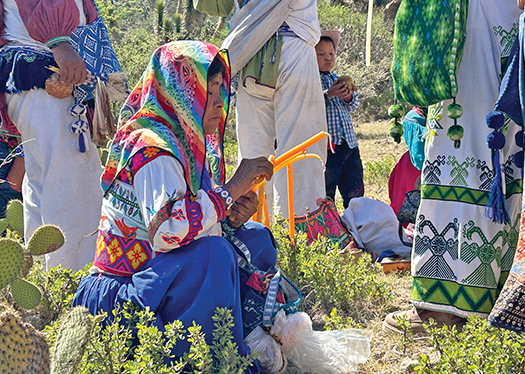
Indigenous Wixárika people pilgrimage every year to Wirikuta, a desert landscape encompassing sites sacred to them. (Top photo by Sincronía Wixárika, index photo by Sebastián Suki Beláustegui.)
A Mexican court has ordered the cancellation of 43 mining concessions in the San Luís Potosí state Protected Area of Wirikuta, a sacred territory of the Indigenous Wixárika people. The precedent-setting, March 11 ruling by the presiding judge of the Fourth Federal District Court of San Luis Potosí state could end 15 years of legal proceedings over local mining efforts, which are aimed mainly at extracting gold and silver.
But the Wixárika Indigenous communities, also known as Huicholes, fault the ruling for failing to cancel an additional 30 or so mining concessions on the outskirts of the 140,212-hectare (346,471-acre) protected area, 20 of which belong to the Vancouver-based Canadian mining company First Majestic Silver Corp.
The Wixárika say that given the hydrology of the region, development of these outlying concessions will pose a threat to the protected area’s water resources.
The Wixárika number some 50,000, with communities spread across four northern Mexican states—Jalisco, Nayarit, Durango, and Zacatecas. Sacred desert sites in Wirikuta, located in San Luis Potosí state, are the destination of an annual Wixárika pilgrimage. In the Wixárika cosmovision, this desert land is where the sun was born and where their supreme deity, Tamatsí Kauyumari, the Blue Deer, dwells. For the Wixárika, the environment and natural elements are inseparable from their culture, identity and existence.
“Our deities are water, air, fire, sky, stars, all the natural elements,” says Aukwe Sofía Mijárez, spokesperson for the Wixárika Regional Council, a coalition of community leaders. “To destroy Wirikuta would be to destroy us, our heart and our source of life.”
In July 2025 almost 500 kilometers (311 miles) of the Wixárika pilgrimage route to Wirikuta were added to the Unesco World Heritage list—the first living Indigenous tradition to be recognized by the UN body in Latin America.
Unesco World Heritage status does not override domestic mining law, but it creates an international obligation for Mexico to ensure that the site’s “outstanding universal value”—the standard Unesco uses in conferring World Heritage status—is not degraded.
“Around the world, legal frameworks fail to value spirituality, which is particularly problematic for living cultures,” says Humberto Fernández Borja, a campaigner for the Wirikuta’s Unesco listing. “Biologists use grid systems to map out and measure the territory while bureaucracies segment the territory with borders. These divisions fail to take into consideration cultures and their spiritual belief systems, which also connect them to their territory and protect it.”
Adds Fernández Borja, an economist and cofounder of Human Conservation, a Mexico City-based nonprofit: “Environmental policies protect flora and fauna, while other frameworks protect culture. But there is a void when it comes to spirituality, it needs to be included within conservation to reflect that many cultures see it as an integral part of their culture and environment.”
Wirikuta is in the Chihuahuan Desert, a vast arid ecoregion that spans multiple Mexican states including Chihuahua, Coahuila, Durango, Zacatecas, San Luis Potosí and parts of the southwestern United States. Though Wirikuta constitutes a tiny fraction of the desert—0.3%—it contains 50% of its plant species, 60% of its mammal species and around 80% of its bird species.
The Sierra de Catorce within the area of Wirikuta hosts 157 bird species, including the golden eagle (Aquila chrysaetos) and the Worthen’s sparrow (Spizella wortheni), one of Mexico’s 51 priority species. The endemic hikuri (Lophophora williamsii), also known as peyote, is a cactus that is central to Wixárika ceremonial life and was listed as vulnerable by the International Union for the Conservation of Nature (IUCN) in 2013.
Resources such as these ought to take precedence over mining, conservation advocates in the region say.
“Outsiders see the desert as a place to extract and exploit resources from,” says Eduardo Guzmán Chávez, a sociologist who has lived in the Wixárika region for nearly 30 years and is a member of Sincronía Wirikuta, a local conservation group. “Interest groups conveniently deny the importance of the resources in the desert so they can prioritize the extraction of minerals that are valued for the insatiable and voracious capitalist system.”
Guzmán promotes regenerative activities that encourage the growth of endemic desert species of benefit both to local communities and to the environment generally.
“[T]he desert is an abundant source of life and could become a center for environmental regeneration,” he says. “For example, the maguey cactus captures more carbon dioxide than pine trees and could be part of a reforestation program. We need to transform the way people think of the desert so the ecosystem is protected and can in turn provide benefits to the world.”
The Mexican government has tried to promote mining as a source of jobs in remote desert communities that have few employment opportunities. Counters Mijárez: “Working in mines is undignified work because it destroys our own home. Those who do not recognize, honor and protect nature, which sustains life, are spiritually impoverished. Outsiders think that because it is a desert they can do what they want, but this is our home and our life.”
Although some mining was occurring in the Wixárika region in the 1970s, it was during Felipe Calderón’s presidency of Mexico, from 2006 to 2012, that the government granted the 77 mining concessions at issue today.
Of these, 43 fell within the natural protected area, which includes the sacred territory of Wirikuta, with the rest nearby. The plans raised concerns that a surge in open-pit operations would pollute rivers, aquifers, land and air, threatening the survival of endemic and endangered species.
In July 2011, Wixárika communities took legal action against all 77 concessions, and in Feb. 2012, the court granted a provisional suspension prohibiting mining exploration and exploitation of the 77 mining concessions while the substance of the case was resolved. This represented the first legal victory for the Wixárika people in the course of the litigation.
Nora Berenice Lorenzana Aguilar, the Wixárika Regional Council’s lawyer since 2011, says a key legal hurdle for the plaintiffs was the difficulty of establishing the Wixárika people have the right to defend Wirikuta when legally they do not own the territory.
“We have had to prove that environmental damage to Wirikuta, their pilgrimage site, will damage the culture, identity and existence of the Wixárika culture even though they do not live there or own the land,” Lorenzana says.
Mijárez says the Wixárika do not seek to own the land, just to have their connection to it be respected. They invited judges in the case to witness a pilgrimage to Wirikuta so they could appreciate the land’s importance to their practices and rituals.
By recognizing Wixárika ancestral territory, rights advocates say, the court ruling sets a precedent for other Indigenous communities with spiritual connections to particular geographical areas. Such decisions, however, could be vulnerable to the government’s assertions of its own rights to subsoil resources.
Says Lorenzana: “There’s a fundamental problem with Mexico’s laws because natural resources mining companies are interested in belong to the state and are considered an issue of national security, which can be used as an excuse to do anything. As long as this is the case, the state can prioritize mining over human rights and continue issuing mining concessions.”
The March ruling also recognized the right to self-determination of the Wixárika and ordered the judgment be translated into the Wixárika language. The court held the government’s mining-approval process contravened the Indigenous and Tribal People’s Convention (ILO 169), a 1989 international treaty on protection of Indigenous rights.
The Wixárika had not been consulted when the 77 mining concessions were granted, their advocates assert. Although this month’s ruling upholds the communities’ rights to consultation, the Wixárika Regional Council is by no means mollified.
“It is not enough to just conduct a consultation,” Mijárez says. “Mining activities should not go ahead unless we consent to them.”
The Wixárika Regional Council argues the court failed to weigh environmental evidence of over-pumping of local aquifers and the incompatibility of mining activity with the preservation of the Wirikuta’s broader hydrological system.
The Mexican Constitution guarantees citizens access to water of sufficient quantity and quality, yet according to the National Institute of Statistics and Geography (Inegi), mining operations have left some 3,500 rural families in the Sierra de Catorce without water.
Says Mijárez: “The lack of water does far more than ruin the ecological balance, it also denies us the possibility of a dignified life.”
Critics assert that a siloing of government responsibilities contributes to such problems. For instance, water is regulated by one government institution, environment comes under the purview of another, and human rights is addressed piecemeal at best, they say.
The Wixárika, by contrast, view the environment and human rights as one. They believe water should not be treated as a series of independent sources, but as an interactive network in which underground and surface water are interconnected.
As such, water—and the pollutants it can carry with it—will in their view inevitably cross political and social boundaries. Hence it makes no sense in the Wixárika cosmovision to tolerate mining contamination of water sources outside the protected area since the pollutants will surely wind up affecting the reserve’s environment and people.
These concerns are cited in a March 30 court appeal, filed by Lorenzana on behalf of the Wixárika Regional Council, demanding the disqualification of all 77 of the originally granted mining concessions.
The appeal, now pending in a mid-level appellate court in San Luis Potosí, could take up to a year to resolve, but the Wixárika appear determined to push for a full mining-concession rollback in the region.
“The natural protected area is not being adequately protected,” says Maurilio Ramírez Aguilar, General Coordinator of the Wixárika Regional Council. “We call on the Mexican state to cancel all 77 concessions.”
- Lara Rodríguez