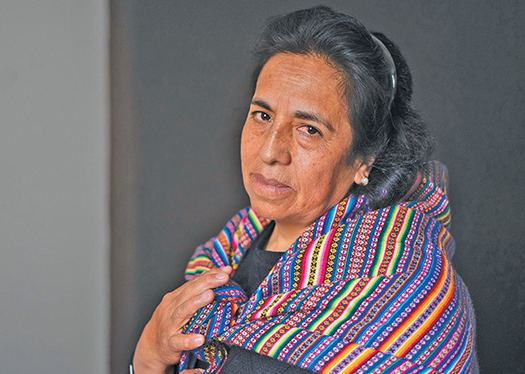
Yolanda Zurita, a petitioner in the La Oroya case, in Montevideo for a 2022 hearing before the Inter-American Court of Human Rights. (Photo by Julieta Bugacoff)
A 19-year-old lawsuit filed against a U.S. company on behalf of 1,373 residents who claimed they were harmed by pollution from an aging multi-metal smelter and refinery complex in the Andean city of La Oroya ended in a US$150 million settlement on July 23, just as a trial was set to begin.
Details of the settlement—which must be approved by the judge handling the case in the U.S. District Court for the Eastern District of Missouri—have not been released. But reports have indicated that Doe Run Resources Corp. of St. Louis, a subsidiary of the New York-based Renco Group, did not admit guilt. Another, similar lawsuit filed by a different group of over 1,000 La Oroya plaintiffs is pending.
The July settlement is only a partial victory in a decades-long battle to clean up the metals-processing complex and provide justice for people affected by decades of severe air, water and soil pollution. In 2024, the Inter-American Court of Human Rights ordered the Peruvian government to take steps to protect people and the environment in La Oroya (See "Inter-American rights court pushes Peru on La Oroya" —EcoAméricas, April 2024), but few of those measures have been implemented.
Meanwhile, the complex, now run by a worker-owned company after a long and contentious restructuring and liquidation process that included a three-year shutdown (See "Moment of truth for Peruvian smelter—and town" —EcoAméricas, September 2010), is now operating at low volume under outdated environmental norms.
The lawsuit that led to July’s settlement was filed in 2007 in Missouri state court on behalf of a small group of children. It was later moved to the U.S. District Court for the Eastern District of Missouri and grew to include 1,300 plaintiffs. Doe Run acquired the smelter complex in 1997, just as then-President Alberto Fujimori privatized nearly all of Peru’s state-run companies. The complex, built in the early 1920s by U.S.-based Cerro de Pasco Copper Corp., was nationalized in 1974 and operated by state-run Centromín Perú until the 1997 sale.
By then, the hills around La Oroya—a city of around 30,000 residents some 3,700 meters (12,140 feet) above sea level and 175 kilometers (110 miles) east of Lima—had been bleached white from acid rain, while soil, air and water pollution abounded. Doe Run won repeated postponements of environmental-management-plan updates, yet raised output using imported concentrates as well as locally mined ore.
Lead threat to children
Studies by the company, Peru’s Health Ministry and the U.S. Centers for Disease Control and Prevention showed that more than 90% of children living nearest the smelter had blood lead levels exceeding the threshold recommended by the World Health Organization. Public health experts generally agree that for children there is no safe level of lead, a powerful neurotoxicant that can cause brain and neurological damage, developmental delay, irritability, seizures, and other health problems.
A coalition of local residents, green groups, and Presbyterian and Catholic organizations with contacts in St. Louis pushed for a cleanup and an end to the delays in updating environmental standards, as the smelter continued to exceed emissions limits. Their efforts led to the lawsuit filed in St. Louis against Doe Run.
Another residents group took a different tack, calling for remedial action in a 2005 Inter-American Commission on Human Rights complaint. The commission referred the case to the Inter-American Court of Human Rights.
In 2024, that rights court announced a ruling requiring Peru to undertake measures aimed at bringing the complex into compliance with international standards. These included remediation of environmental damage, provision of specialized health care, relocation of families eager to move away, and protection from harassment of people advocating for cleanup and restitution. The decision, involving 80 residents—was among the first in which the Inter-American Court upheld the right to a healthy environment. It ruled Peru had failed to prevent environmental harm by allowing the smelter to pollute La Oroya air, soil and water.
So far, however, the only court-ordered measures the government has complied with are publicity of the court’s decision and payment of plaintiffs’ legal fees, says Rosa Peña, coordinator of the human rights and environment program of the Interamerican Association for Environmental Defense (AIDA). Criminal investigations into environmental damage and harassment of members of the coalition that has fought for cleanup are in initial stages, she said.
Meanwhile, the smelter is operating under environmental management plans that haven’t been updated in over a decade. “It is not even operating at 50% [of its capacity],” Peña says. “The problem is it’s operating with infrastructure that is completely obsolete and with inadequate environmental management measures.”
Government follow-up urged
Those involved in bringing the Inter-American Court case are urging the Peruvian government to set deadlines and a budget for compliance work and identify the agencies responsible. They also demand health care for affected residents, payment of court-ordered compensation to victims and a halt to smelting operations until an environmental-management plan is drafted that meets court standards.
Yolanda Zurita, a leader of the grassroots campaign that led to the Inter-American case, was finishing university studies when she learned about the effects of lead poisoning and realized seizures she had begun to suffer could be related to pollution from the smelter.
Despite Peru’s lack of compliance with the court’s orders, she says, progress has been made. When Doe Run bought the smelter, few people talked about green standards, health impacts from pollution or the effects of exposure to substances other than lead. Now the Health Ministry has an area dedicated to toxic metals. Nevertheless, Zurita adds: “I’m not going to reap what I’ve sown” through the decades of effort that led to the Inter-American Court decision.
Hunter Farrell, a Presbyterian minister who organized a joint campaign involving La Oroya residents and Presbyterian partners in St. Louis, says the court decision highlights the effectiveness of a tenacious coalition. “It actually changed the course of history,” he says. “It changed the plans and profit margins of a very powerful U.S. multinational corporation in ways the corporation was actively resisting.”
- Barbara Fraser