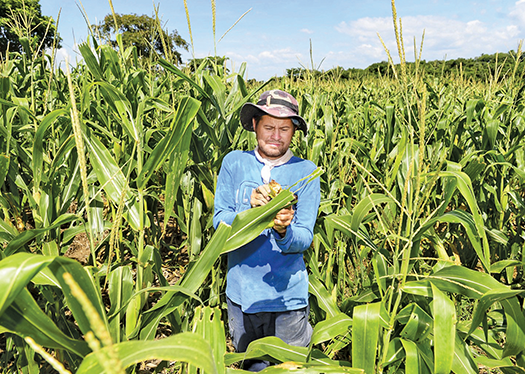
Drought in El Salvador has dramatically depressed corn yields. (Photo by Jessica Orellana)
At first glance, the cornfields lining rural roads in the northern portion of El Salvador’s San Vicente department give the impression of crops on the verge of ripening, with row after row of stalks standing upright, and their ears—though noticeably small—clearly visible. A closer look, however, reveals these crops will yield no grain. The ears are in a state local farmers call “mulquite,” meaning they’re stunted, having dried out prematurely.
The situation in San Esteban Catarina reflects a silent environmental and social disaster gripping Central America’s Northern Triangle countries of Guatemala, El Salvador and Honduras. With the onset of the El Niño weather pattern—exacerbated by climate change and rising average temperatures—the region is experiencing prolonged water deficits and droughts that threaten the food security and livelihoods of millions of people. The difficulties underscore the extreme vulnerability of rural Northern Triangle communities to climate change. With little stored food and few resources to settle planting-season debts, the region is facing a severe food-sovereignty test.
For siblings Luz Elena and Manuel Calderón, who have spent nearly their entire lives farming in the San Vicente municipality of San Esteban Catarina, damage to their respective corn crops ranks among the worst they’ve ever seen. “We hadn’t lost an entire corn crop since 1998,” Manuel recalls, referring to the year when torrential rainfall from Hurricane Mitch caused their corn to rot in the field. This time, the threat stems from a prolonged lack of water during the crop’s most critical growth stages.
Luz Elena has a broad view of the problem as secretary of the La Esperanza Agricultural Supply Cooperative (Acalese de R.L.), a local association representing over 200 small-scale producers. She says that although she planted her corn on June 17 and 18, the resulting stalks remain under half a meter tall more than three months later, their ears too weak to produce kernels. She estimates 90% of her crop is lost, and Manuel reckons his losses at 80%.
Experts say the collapse stems from erratic rainfall experienced since May with the onset of the current El Niño weather pattern. San Esteban Catarina experienced consecutive weeks without rain during the critical months of July and August, when growing corn requires the most moisture. Francisco Barahona, a small farmer, estimates he has lost up to 75% of his harvest in a season in which he has seen only four significant rains as of the end of August.
Would early planting help?
As production slumps, debate has broken out about whether farmers could have avoided such extreme losses if they had heeded government recommendations to plant in late April, which is earlier than usual. Salvadoran Deputy Minister of Agriculture and Livestock Óscar Domínguez made this assertion in August, but farmers challenge the contention. “The rainy season began with a drought,” Luz Elena Calderón says, noting April rains were too scant to reach roots. “If we’d planted in the last week of April, the crop would’ve been lost anyway.”
Financial strain is compounding the environmental pressure. Most small-scale producers rent their land at a rate of about US$200 per manzana (1.7 acres) annually and also struggle to meet the high costs of fertilizers, pesticides, seeds, and labor. Luz Elena estimates her production costs total $1,000 per manzana. In a good year, this would yield profits per manzana of up to $700. Under current conditions, she says her sale of corn she can salvage won’t even cover the cost of renting the farmland.
“We haven’t made a profit this year; on the contrary, we’ve lost money,” she says. Without a harvest, farmers like Barahona will have to turn to informal work, such as masonry. “Most of us farmers have limited resources and are disheartened. We’re already considering not planting at all, or perhaps just cultivating small plots for personal consumption—just enough to make tortillas and survive,” Luz Elena concludes.
The situation in San Esteban Catarina is not unique. It stems from a national and regional water crisis. El Salvador has experienced 14 record-high temperatures in recent months. In the southern part of San Vicente department, farmers like Dolores Menjívar lost $1,000 investments in corn crops and saw their household wells run dry. The Salvadoran Chamber of Small and Medium Agricultural Producers (Campo) warns that the first harvest of staple grains, which takes place during August and September, will reflect an aggregate loss of at least 20%. The poor results extend across the Central American Dry Corridor, a semi-arid ecoregion which spans parts of Guatemala, El Salvador, Honduras and Nicaragua and is home to over 10.5 million people, many small farmers.
Widespread drought
In Honduras, the Secretariat of Risk Management and National Contingencies (Copeco) declared and extended a severe-drought alert in 103 of the country’s 298 municipalities. The country’s National Center for Atmospheric, Oceanographic, and Seismic Studies (Cenaos) says El Niño caused March-through-August rainfall deficits totaling 100 to 200 millimeters and an average-temperature increase of up to 1°C. The combination destroyed entire crops of corn and beans—staples of the Central American diet—weakened livestock production and forced water rationing in the capital, Tegucigalpa, amid declining reservoir levels.
The severity of the impact on farming families necessitated an urgent international response to avert mass famine. Alejandro Álvarez, the United Nations Resident Coordinator in Honduras, announced an additional $20 million allocation to address the drought, bringing the total funds mobilized by the U.N. for this water emergency to $86 million.
Drought has also devastated subsistence crops in eastern Guatemalan municipalities. With wells dry and grain reserves tapped out, farmers there are turning to day-labor work on export-oriented melon farms. Agricultural-extension specialists say if drought decimates future crops, more farmers will migrate to Guatemalan cities or the United States to find work.
“We use money from selling peanuts to buy the corn and beans that we eat; the corn crop dries out quickly, and the peanuts are more drought-resistant,” says Felícito Marroquín, a peanut and corn farmer in the community of El Jícaro, Guatemala. Looking at the withered plants of both crops lying in cracked soil, he adds: “But this year we got nothing.”
- Jessica Orellana