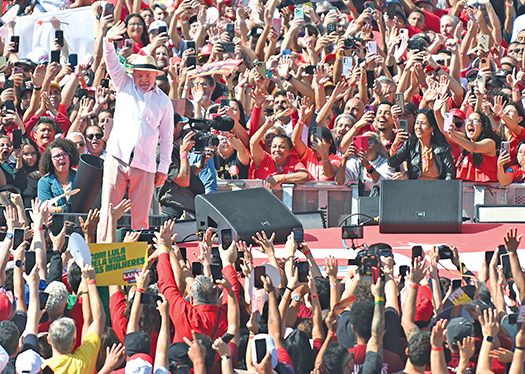
Brazilian President Luiz Inácio Lula da Silva waves to supporters at his August campaign kickoff rally. (Photo by Antonio Scorza / Shutterstock.com)
Considering who the two candidates are—left-leaning incumbent Luiz Inácio Lula da Silva and far-right challenger, Senator Flávio Bolsonaro—it’s hard to escape the conclusion that Brazil’s upcoming presidential runoff represents, at least in part, a pivotal clash of environmental visions.
Bolsonaro, a 45-year-old national senator, holds the staunch anti-regulatory stances of his father—one-term President Jair Bolsonaro. The elder Bolsonaro, a 71-year-old former Army captain, is banned from public office and remains under house arrest for encouraging a coup after losing a 2022 reelection bid to Lula, 80, a former union leader now serving his third term as president.
And Lula, though criticized by green advocates for favoring certain environmentally threatening, big-ticket energy and infrastructure initiatives, is widely credited with slowing Amazon deforestation and taking climate change far more seriously than either the elder or younger Bolsonaro.
Lula and Flávio Bolsonaro emerged as the two top vote-getters in a field of 12 candidates in the first round of presidential voting on Oct. 4. With 99.99% of ballots tallied as of press time, Bolsonaro had received 47.03% of the vote and Lula collected a lower-than-expected 45.16%, with the other candidates splitting the rest. Since no candidate garnered over 50% of the vote, the top two finishers must meet in a runoff, which is scheduled for Oct. 25.
At first glance, Lula’s and Bolsonaro’s environmental platforms might appear puzzlingly similar in certain respects.
Both candidates pledge greater satellite monitoring of forests and the use of artificial intelligence to fight environmental crimes such as illegal deforestation. Both vow to tackle the country’s organized-crime networks, some of which are being targeted by Lula administration enforcement action to help stem illegal Amazon gold mining and land-clearing. (See "Brazil waging environmental crime crackdown in Amazon" —EcoAméricas, July 2026.)
The two also endorse development in Brazil of a regulated cap-and-trade market for carbon credits based on initiatives that produce measurable reductions in greenhouse-gas emissions. And both back expansion of Brazil’s bioeconomy through increased output of value-added products ranging from biofuels and foods to plant-based medicines and cosmetics. To that end, Lula’s government in April launched a program that calls for government loans, price subsidies and other bioeconomy supports. (See "Brazil launches plan to promote ‘bioeconomy’" —EcoAméricas, June 2026.)
And they share more politically problematic planks such as support for development of data centers, rare-earth mining and economic-development initiatives that green advocates say would in various ways unduly consume and harm natural resources. The development initiatives include road, rail and dam construction that experts say would likely fuel Amazon deforestation, as well as offshore oil and gas projects that critics argue would pose a marine-pollution threat and undermine the transition from fossil fuels.
Philosophical divide
The apparent similarities, however, mask a deep philosophical rift on environmental matters. Experts say that based on Lula’s record over decades and Flávio Bolsonaro’s embrace of his father’s views, the two represent diametrically opposed approaches that, depending on which one is chosen, would take Brazil in dramatically different green-policy directions.
The divide is especially stark when it comes to actual forest- and climate-protection outcomes under Lula and Flávio Bolsonaro’s father. Jair Bolsonaro, dubbed the “Trump of the Tropics,” presided from 2019 through 2022 over dramatic green-policy and enforcement rollbacks that fueled enormous increases in deforestation in the Brazilian Amazon. Deforestation is by far Brazil’s biggest source of greenhouse-gas emissions, accounting for 46%.
Throughout his single term in office, the elder Bolsonaro stifled environmental funding, regulations and enforcement. The impacts were manifold, but arguably the most notorious was a surge in Amazon woodland destruction by illegal loggers, gold miners and land grabbers.
The pace of deforestation in the biome increased 73% in the three years starting Aug. 1, 2018—five months before the elder Bolsonaro took office and largely on expectations of his election, experts say—and ending July 31, 2021.
The results reflected a dismantling of forest-protection initiatives Lula had implemented during two consecutive terms he served as president from Jan. 1, 2003 to Jan. 1, 2011. Analysts view stronger monitoring and enforcement efforts against illegal land clearing under Lula as the crucial driver of an 83% decline in Brazilian Amazon forest loss during 2004-2012.
Since the spike of deforestation under Bolsonaro, Lula has spent his current presidential term, his third, rebuilding his earlier forest-protection programs and expanding them from the Amazon to all six of the country’s biomes. His highest-profile conservation focus, though, remains the Brazilian Amazon, which has experienced the greatest cumulative forest loss of any of the country’s six biomes—up to 20% since 1988, the government says.
Lula’s efforts have borne fruit, producing an 11% drop in Brazilian Amazon land clearing during the 12-month period ending July 31, 2025 compared to the previous 12 months. Experts project data will show a further 36.9% drop during the 12-month period ending July 31, 2026. That would mark the lowest deforestation rate in the region since 2015.
In his campaign platform, Lula pledges to “keep working to achieve net-zero deforestation by 2030,” a goal set in his administration’s 2024 update of the country’s Paris Agreement climate targets. His government has said it will do so in part by reforesting denuded land in all six Brazilian biomes, using native species.
For his part, Bolsonaro promises “to eliminate illegal deforestation by 2029,” not mentioning native-forest restoration nor making clear what types of land clearing will be considered legal. Critics assert that the comparative vagueness of Bolsonaro’s forest-policy platform language is deceptive, pointing out that his father’s campaign platform in 2018 also contained positive-sounding forest-conservation language later belied by his administration’s actual policies. (See "In some ways, Bolsonaro and Lula platforms appear similar" —EcoAméricas, August 2022.)
“The focus of Bolsonaro’s platform only on ending illegal deforestation suggests he will do nothing to reduce deforestation that may appear legal but which is not because it is based on land claims, especially in the Amazon, that in many cases are forged [usually by land grabbers] and thus fraudulent, land claims his platform pledges to legalize,” says Philip Fearnside, a researcher in Amazon ecology at the National Institute of Amazon Research (INPA). “By contrast, Lula’s platform, which aims for net-zero deforestation by 2030, involves reforesting degraded woodlands—restoration work that Bolsonaro’s platform doesn’t even address. This gives it a much broader scope and takes the need to reduce forest loss much more seriously.”
Regarding the candidates’ pledges to bring more satellite monitoring and artificial intelligence to bear on forest protection, green advocates say Lula would be far more likely to honor that commitment.
Agribusiness ties
The reason, they argue, is that the incumbent is far less beholden than Bolsonaro to agribusiness interests, which have great clout in Congress and regularly block land-use restrictions that might hinder agricultural expansion.
“The anti-illegal-deforestation pledges in Bolsonaro’s platform are nothing more than greenwashing,” says Carlos Bocuhy, president of the nonprofit Brazilian Environmental Protection Institute (Proam). “Lula, whose party does not have ties to the agribusiness lobby and whose record of having brought down the Brazilian Amazon deforestation rate greatly in his three terms in office, is far more likely to comply with his platform’s pledge to continue the crackdown on illegal deforestation.”
At the urging of the agribusiness lobby, Bolsonaro aims to further relax environmental-licensing regulations following an already extensive rollback last year that environmentalists dubbed the “devastation bill.” Lula tried to kill what he considered the bill’s worst provisions, but Congress overrode all but five of his 63 vetoes before he was forced to sign the bill.
On anthropogenic climate change, Flávio Bolsonaro, like his father, denies the existence of the problem, which he does not mention in his campaign platform. He first denied climate change in a televised 2019 interview, calling it “an apocalyptic narrative that hinders progress.” In a televised interview in late August, he said, “extreme climate events are cyclical” and not necessarily related to human influence. He added that the “best way” to combat extreme climate events is to expand and improve sewage treatment and solid-waste removal, an assertion climate experts dismiss as entirely groundless.
Bolsonaro’s platform pays little notice to the need to wean Brazil from fossil fuels. It does, however, say the country should use its efforts to produce biofuels, solar power and wind energy to attract foreign investment.
And though the challenger does not explicitly acknowledge a need for climate-change mitigation or adaptation, he does propose “expanding infrastructure via flood-control reservoirs, dikes, and drainage works.” Such infrastructure would presumably aid in the adaptation to extreme weather—in this case, the intense rains—expected as a result of climate change.
Lula’s platform, by contrast, openly emphasizes the need to use dedicated financing and other means to speed expansion of renewable power and replace fossil fuels progressively with biofuels such as ethanol, biodiesel and biomethane. The incumbent’s governing blueprint mentions climate-change mitigation eight times and pledges to “institutionalize climate adaptation” as a permanent feature of his administration’s National Climate Change Plan.
Mapping mitigation, adaptation
That plan was launched in March by Brazil’s Environment and Climate Change Ministry with input from 24 other federal government ministries. It outlines eight mitigation and 16 adaptation initiatives involving multiple government ministries, aiming to mitigate greenhouse-gas emissions and manage climate impacts through 2035. The Environment and Climate Change Ministry has also initiated a program to strengthen the ability of the country’s 581 municipalities in 27 states to develop local adaptation plans of their own.
Addressing Bolsonaro’s lack of climate-change mitigation proposals, Lula on Aug. 30 issued a statement in which he described the senator as “the portrait of people who sell simple solutions for complex problems.”
Many environmental experts agree.
“Lula’s platform, whose [proposals] are much more detailed than those of Bolsonaro, specifies how he would mitigate the catastrophic impacts of climate change,” says Adriana Ramos, a public policy specialist with Brazil’s nonprofit Socio-Environmental Institute (ISA). “By not even mentioning climate change in his platform, Bolsonaro shows how little he is concerned about mitigating its impacts.”
Lula’s platform also confirms Brazil’s Paris agreement commitments, which his administration strengthened in 2024, pledging greenhouse-gas emissions reductions of 59% to 67% by 2035 compared to 2005. This would be accomplished mainly by reducing deforestation, given that land clearing—most of which occurs in the Amazon—represents the country’s single largest source of greenhouse-gas emissions.
While they consider Lula dramatically more proactive in addressing climate change than Bolsonaro, environmentalists strongly criticize him for supporting development of “new reserves” of oil and gas. Those initiatives, the most prominent of which is to find and develop deepwater hydrocarbon reserves off Brazil’s northern coast, could make the country’s Paris climate goals much harder, if not impossible, to achieve, they say.
“Perhaps the most glaring environmental contradiction in Lula’s platform is its aim to reduce GHG emissions by 2035, while at the same time extracting oil and gas from new reserves,” INPA’s Philip Fearnside says. “Producing oil and gas in new reserves, as opposed to existing ones, creates an economic mechanism that leads to extracting huge volumes of these fossil fuels long after the world will need to stop producing them to avoid the catastrophic impacts of climate change. So I think that it is impossible for Lula, if he wins reelection, to achieve these competing and contradictory aims, especially when producing oil in new reserves is one of his main priorities.”
Bolsonaro’s platform, Fearnside adds, doesn’t mention Brazil’s updated commitments under the Paris agreement, let alone whether or how he would comply with them.
- Michael Kepp
In the index: Flávio Bolsonaro greets supporters at his August campaign launch. (Photo by Focus Pix/Shutterstock.com)