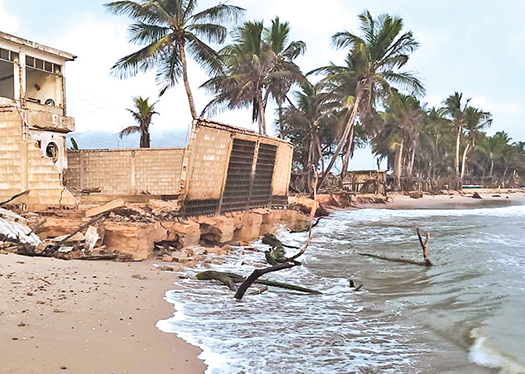
Scenes from the villages of El Hatillo and La Cerca (above and in the index) illustrate the toll sea-level rise and wave action from stronger storms are taking along Venezuela’s Caribbean coast. (Photos by Giovanna Pellicani)
For more than a decade, crisis-torn Venezuela has drawn world concern for its high levels of poverty, mortality and emigration. Despite U.S. claims that the recent capture and removal of Venezuelan President Nicolás Maduro will bring better times, these problems and their effects are unlikely to ease anytime soon.
Meanwhile, the country faces a more insidious but potentially devastating problem—sea-level rise, which scientists say puts some 80%, or 4,850 kilometers (3,104 miles), of Venezuela’s coastline at risk of flooding and erosion. The danger has been heightened due to decades of inattention to the problem under Maduro and his predecessor, Hugo Chávez, who exercised increasingly authoritarian rule over Venezuela from 1999 until his death in 2013. Rather than mitigating the effects of sea-level rise, the Venezuelan government has not only ignored but in some ways exacerbated them, according to experts who have warned of social and environmental dangers for decades.
Ocean levels have risen 12 centimeters since 1993 in Venezuela, according to The Sea Level Explorer, a tool developed by the NASA space agency in cooperation with other U.S. and international agencies. This is an average rise of 0.375 centimeters annually from 1993 to the end of 2025 and jibes with the generally accepted Caribbean average of 3 to 4 millimeters per year.
The Sea Level Explorer, which presents past, current and projected sea-level rise for all of the world’s coastal countries, estimates that worldwide, ocean levels rose 10 centimeters from 1993 to 2025. It forecasts that in Venezuela the sea level will rise a further 17 centimeters from 2020 to 2050, with subsequent increases depending on the success of world efforts to curb greenhouse-gas emissions and slow the pace of warming.
Large swathes of Venezuela’s Atlantic coast, which runs east of the Paria Peninsula to the Guyana border, have already felt significant effects of sea-level rise. Much of this region is swampy and thus has remained largely undeveloped. However, dozens of Atlantic coast communities in the Orinoco Delta and Gulf of Paria region are at risk, experts say.
On Venezuela’s Caribbean coast, sea-level rise is threatening communities on the shores of Lake Maracaibo—the brackish, semi-enclosed inlet of the Caribbean—and coastal settlements in Anzoátegui state, the Paraguaná Peninsula and the Colombian department of La Guajira.
“I am watching my village disappear before my eyes, while the authorities do nothing,” says 75-year-old Aura Boada, who founded the village of La Cerca in the state of Anzoátegui in the 1960s.
Back then, the village was a kilometer or so from the Caribbean shoreline. Today Boada’s home, where she lives with her daughter and granddaughter, is only 60 meters from the water. “Other homes are just three meters from the sea,” Boada says. “The waves crash into their homes when the tide is high.”
La Cerca has lost four homes to the rising sea level, while the toll in nearby El Hatillo is 15. Together these two communities in the municipality of Peñalver have a population of some 2,500 people, many of whom make their living fishing for prawns, squid and octopus. They occupy an area of the coast encompassing lagoons, mangroves and flood-prone plains.
Local plant and animal life is also under threat in the face of the receding coastline. Such is the case in Anzoátegui’s nearby Unare Lagoon, home to some 125 species of birds according to BirdLife International.
“This is an important feeding ground for many bird species,” says Boada for whom the flamingos (Phoenicopterus) and white herons (Ardea alba) are an important part of the local landscape that the government should be protecting both to promote ecotourism as a livelihood and to protect the ecosystem.
Boada and others complain the government has largely failed to recognize such problems, let alone provide the provisions, relocation help and economic assistance vulnerable coastal communities need. “Our village and all the surrounding areas are disappearing, yet this government has done absolutely nothing to help since they came into power,” Boada says.
Climate impacts such as sea-level rise, to be sure, are visible in various countries fronting the Caribbean. But experts say the problem is exacerbated in Venezuela by the severe lack of funding and hard scientific data with which to address it.
On Dec. 3, 2025, The Second Academic Report on Climate Change for Venezuela was presented in Caracas by Alicia Villamizar, who heads the climate-change academic secretariat of the Venezuelan Academy of Physical, Mathematical and Natural Sciences (Acfiman). Unsurprisingly, the report’s overarching conclusion was that in order to address the problem of climate change, more data is needed to gauge and assess the problem.
Villamizar, a biologist, oversaw the report’s preparation over four years by a group of 55 professionals from 25 different institutions, including the Central University of Venezuela (UCV) and Universidad Simón Bolívar (USB). There is general consensus that the lack of data during the rule of Chávez, Maduro and now acting President Delcy Rodríguez has been crippling for climate efforts.
Liliana Rivas, coordinator of a separate report on Venezuelan sea-level rise, says her team of five researchers and journalists requested data the Venezuelan Navy regularly gathers on ocean levels, sea and air temperatures and other climate indicators. But the government has been reluctant to acknowledge sea-level rise, she and other experts say, and access to the information was denied.
Rivas, whose report was funded by the nonprofit Netherlands-based Free Press Unlimited, found that even the nation’s ministries in charge of science and environment do not have access to the necessary data. She says her team had to depend instead on satellite-monitoring information available on the U.S. National Aeronautics and Space Administration (NASA) Open Data Portal, an online repository of a wide range of datasets.
Rivas says the report, titled Climate Displacement, did not meet with the government censorship and harassment often directed at Venezuelan research efforts—possibly because it received funding from abroad. But the potential for government interference was always a concern.
“You wouldn’t think research [of scientific issues] would be seen as a threat by the government, but we journalists feel threatened and limited,” she says. “Just covering science and environment in this country is complicated. There is always a silent threat. They don’t need to be pointing the gun at me for me to feel scared.”
In the end, the team was able to assemble some of the data it needed, but the Navy’s refusal to share data made it impossible to render a more complete picture of sea-level change in the country. Says Rivas: “The satellite-generated information is a good start, but we still have a void because satellite data needs to be cross-checked and compared by experts in the field.”
Meanwhile, climate effects will only intensify. According to the latest IPCC report, high tides will become higher and more frequent, causing greater damage to beaches and dunes. The trend is already reflected in data on the Sea Level Explorer, which documents that along the coastlines of Venezuela there was nearly a three-fold increase in the number of high-water days in the period 2005 to 2015 compared to the period 1980-1990.
Also contributing are ill-considered government policies in recent decades. For instance, La Cerca and El Hatillo lie close to the Unare River delta, which since the 1970s has been starved of sediment due to upstream water-diversion and hydroelectric projects. The reduction in downstream sediment deposits has left the coast more vulnerable to erosion, effectively amplifying the effects of sea-level rise.
“When you interrupt the natural flow of water downstream to the sea, the beach is no longer being adequately topped up with enough fluvial sediment,” says Orlando Cabrera, a Central University of Venezuela geomorphology professor who has monitored sea-level rise in the two villages since 2005. “Meanwhile, the sea’s waves and tides continue to wear down the beach, resulting in erosion and eventually a change in the coastline. This is what has happened in El Hatillo and La Cerca as a result of the interference upstream in the Unare river.”
Government-led coastal construction of wave breakers, piers and esplanades also proved counterproductive. Says Cabrera: “The sea naturally distributes sediment, but when there are artificial obstructions like wave breakers, the sediment is unevenly spread out. This accelerates soil erosion.”
Also causing concern are rising water tables. Saltwater enters underground aquifers as a result of sea-level rise and, because it is relatively heavier, squeezes fresh water upwards—closer to the foundations of buildings, endangering their stability. For Jorge Naveda, a UCV professor of ecology and author of a 2010 report on coastal impacts from Venezuelan sea-level rise, the only solution for the communities of La Cerca and El Hatillo is to relocate.
“The government has no money for the repairs to the infrastructure as sea level rise causes problems with basic services, a deterioration in metallic infrastructure and floods wells,” Naveda says. “The villages will empty out and only those who resist change will remain. The rest will migrate.”
Climate migration, already well underway in Latin America, stands to accelerate enormously as coastal waters creep inland, yet Venezuela’s government has no public data available on the phenomenon. The Inter-agency Coordination Platform for Refugees and Migrants (R4V)—a collaborative of UN agencies and civil society groups—calculates that over 6.9 million refugees and migrants have left Venezuela for countries elsewhere in Latin America and the Caribbean since 2017.
The R4V has not estimated how many of those are climate refugees, but ongoing drought in Venezuela, which has led to rationing of drinking water and hydroelectricity, is widely recognized as an important contributor. R4V says that while Venezuela’s socio-political instability is considered a key migration driver, climate change is a “threat multiplier.”
The overall economic effects of climate-related changes also are a factor, experts say. The Acfiman report calculated that climate change contributed to a reduction of 0.97% to 1.3% in the country’s gross domestic product (GDP) from 2010 to 2020, partly due to rising temperatures and increased rainfall. From 2000 to 2019, Venezuela experienced over 20 flooding events, which collectively are calculated to have caused economic losses of more than US$1 billion, according to the nonprofit Center for Research on the Epidemiology of Disasters (CRED) at Belgium’s University of Louvain.
Experts agree that the most immediate challenge in Venezuela is to get the government to recognize and openly assess the problem of climate change and its various local impacts—sea-level rise included. During the presentation of the Acfiman report, Villamizar stressed the findings should not “remain confined to academia.” Instead, she said, the report aims to stimulate climate-change research and institutional capacity in Venezuela.
- Lara Rodríguez