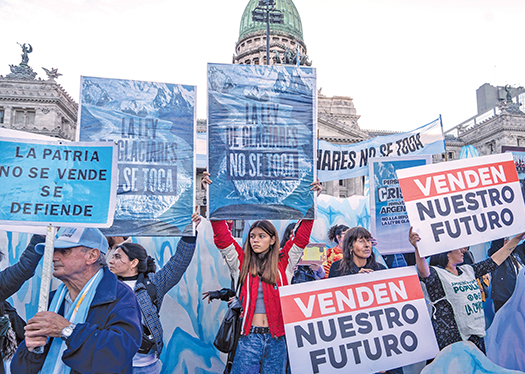
Opponents of the glacier-law amendment rallied outside the Argentine Congress as legislators debated the measure. (Photo courtesy of Greenpeace)
Argentine environmental organizations aim to enlist more than one million people in “the largest legal challenge in history,” the goal being to overturn recently approved legislation that weakens the country’s landmark glacier-protection law.
The bill to alter key provisions of the Glacier Law won congressional passage on April 9, propelled by strong support from right-wing Argentine President Javier Milei and governors of Andean Mountain provinces interested in attracting large-scale mining projects.
Congress enacted the Glacier Law in 2010 with the goal of ensuring Andean icefields can continue to serve as vital sources of fresh water for communities and ecosystems stretching from the mountains downslope to the country’s Atlantic coast. Alongside Argentina’s Native Forests Protection Law, the Glacier Law until now had been regarded as one of the country’s two most important environmental conservation laws.
The 2010 legislation imposed an absolute ban on mining and other destructive economic activities on glaciers and on rock glaciers, whose interiors contain ice, as well as in the frozen periglacial areas that surround glaciers.
The amendment passed in April empowers Andean provinces to authorize industrial activity in glacial areas that do not demonstrate “effective hydrological function”—a determination that will be left up to provincial authorities. The measure cleared the Argentine Senate Feb. 26 by a vote of 40 to 31 and prevailed in the Chamber of Deputies on April 9—the lower house of Congress—by a margin of 137 to 111.
As of April 24, three leading Argentine environmental organizations and dozens of grassroots groups had collected 868,119 signatures endorsing a legal challenge to the amendment. They aim to gather a million. The three organizations—Environment and Natural Resources Foundation (FARN), Argentine Association of Environmental Lawyers and Greenpeace—are expected to file the suit soon, since the amendment became law on April 24.
“Deputies and senators have betrayed the Argentine people,” the three organizations said in a joint statement issued April 10, referring to members of the lower and upper houses of Congress. “Local communities were disregarded, scientific and technical input was ignored, expert voices were dismissed, and opportunities for public participation were curtailed.”
Constitutional challenge
In comments to EcoAméricas, FARN Executive Director Andrés Nápoli said he and other critics of the amendment believe the measure is vulnerable on constitutional grounds.
“While, under Argentine law, the provinces hold ownership of their natural resources, the Constitution enshrines the right of the country’s inhabitants to live in a healthy environment,” Nápoli said. “To this end, it tasks the National Congress with enacting laws establishing minimum standards for environmental protection—such as the Glacier Law—which must be upheld throughout the entire national territory. Provinces cannot simply do whatever they please with glaciers—as is currently being proposed—and for that reason, we consider this legislation to be unconstitutional.”
Added Nápoli: “Another argument central to our legal challenge is that the measure violates the Escazú Agreement—the first environmental treaty in Latin America and the Caribbean—which prohibits Argentina and other signatory states from rolling back environmental protection standards.”
Organizers of the legal challenge say they plan to cite procedural irregularities regarding the amendment process. As an example, they point out that 102,000 people registered to participate in a public hearing on the measure convened by the Chamber of Deputies—the lower house of Congress—yet the body ultimately allowed only 200 individuals to participate due to time constraints. Said Nápoli: “They could have authorized simultaneous hearings in the country’s interior or sought alternative solutions to avoid violating the fundamental principle of citizen participation.”
Mining industry leaders applauded April’s congressional action, saying it will help ensure project investment and planning can take place in a climate of greater certainty than in the past.
“This is a fundamental step for the country, as it strengthens the protection of water resources while enabling responsible and sustainable productive development in the regions,” the Argentine Chamber of Mining Entrepreneurs (CAEM) said in a press release, asserting that the initiative had garnered “broad and diverse political support.”
Keen investor interest
Mining is currently on the rise in Argentina. In 2025, it generated exports totaling US$6.073 billion—a 30% increase over the previous year—with gold, lithium, and silver leading the way, according to official data. The industry forecasts amendment of the glacier law could spur US$30 billion in investment in Argentina over the next 10 years. Copper—the focus of intense demand as a key ingredient in the world energy transition—is expected to be the greatest focus of the new activity.
However, Argentina’s feisty environmental movement is not the only group weighing in against modification of the Glacier Law. The day after the amendment cleared Congress, the province of La Pampa filed its own legal challenge in federal court seeking to have the legislation declared unconstitutional.
La Pampa borders the Andean province of Mendoza. It has previously filed suit in the Supreme Court, claiming that its rivers have seen water volumes shrink due to Mendoza’s upstream construction of irrigation dams.
“If they deprived us of two of our three rivers—all of which are glacial in origin—even while the glaciers were supposedly protected, what kind of future awaits us now?” La Pampa Governor Sergio Ziliotto said. “We are not opposed to mining per se, but we are firmly opposed to granting the mining industry priority access to water over human consumption.”
Speaking with EcoAméricas, Andrés Gil Domínguez, La Pampa’s legal counsel, put the province’s case this way: “The Atuel River originates in Mendoza; yet today, within its riverbed on Mendoza’s territory, one could literally play a game of soccer. The entire western region of La Pampa has been reduced to desert. That is why we are demanding the total and immediate suspension of the amendment to the Glacier Law.”
- Daniel Gutman
In the index: Members of Argentina’s lower house of Congress who backed a proposal to modify the nation’s Glacier Law celebrate following the measure’s passage on April 9. (Photo courtesy of Cámara de Diputados)