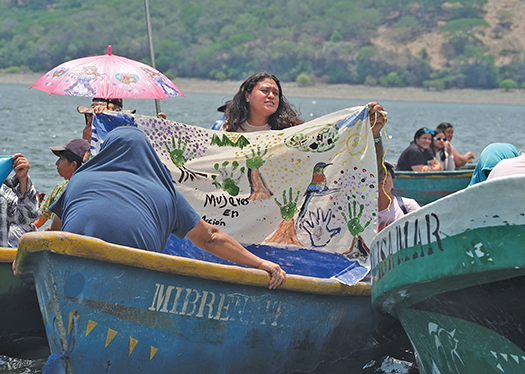
Opponents of the Aura Resources mining project staged an “Aquatic March” on April 24. (Photo by Jessica Orellana)
Blanca García of Guatemala steers the lead vessel in a small fleet of outboard fishing boats cutting through the calm waters of Lake Güija, the picturesque volcanic lake located on the Salvadoran-Guatemalan border. The sounds of Guatemalan, Honduran and Salvadoran flags fluttering overhead punctuate the drone of the engines as dozens of other boats proceed in line behind hers.
This is no ordinary fishing day. It is April 24th, and hundreds of protestors are staging the Sixth Aquatic March, the latest in a series of annual waterborne demonstrations against development of a proposed gold- and silver-mining project in Guatemala.
Attended by activists, local fishers and community groups, the protest aims to spotlight concern that pollutants from the mine—located in Asunción Mita, a municipality in southeastern Guatemala’s Jutiapa Department—will foul the watershed that includes Lake Güija. A natural outflow channel carries water from the 45-square-kilometer (17-sq.-mile) lake to the Lempa River—El Salvador’s main source of drinking water.
This year, the protest is also directed against persecution of environmental organizations and other civil-society groups in El Salvador by the administration of President Nayib Bukele. Concerned about that repression, demonstrators this year for the first time launched the Aquatic March from Guatemala’s portion of Lake Güija rather than from Salvadoran territory.
At issue is a project that has been a longstanding flashpoint for environmental debate in Guatemala and El Salvador. Formerly named Cerro Blanco and now dubbed Era Dorada, or Golden Era, the gold and silver mining project is being spearheaded by Aura Minerals. The Canadian company added the controversial project to its portfolio after acquiring the concession’s previous owner—Bluestone Resources, also of Canada—in Jan. 2025.
Bluestone’s subsidiary in Guatemala, Elevar Resources, had earlier attempted to modify the original permit for the project to allow open-pit mining, and in Jan. 2024 reported the Guatemalan Ministry of Environment and Natural Resources (MARN) had approved the move. But in June 2024, after the current government of Guatemalan President Bernardo Arévalo had succeeded that of predecessor Alejandro Giammattei, authorities canceled the MARN approval. They alleged administrative irregularities involving the MARN approval as well as deficiencies in an environmental-impact-study update Bluestone’s subsidiary had submitted in 2021 in connection with the switch to an open-pit-mining plan.
Aura promises new approach
After acquiring Bluestone last year and adding the mining project to its holdings, Aura pledged to mine underground, as first planned, and to operate in line with the original, 2007 environmental-impact study. It also said it would recycle water to ensure pollutants do not enter local water sources.
Preparatory work began under the new owners this year. It has involved the rehabilitation of tunnels dug previously and the installation of water-management systems. The latter activity is considered crucial, analysts say, because in the previous attempt to develop the mine under Bluestone’s then-subsidiary Elevar Resources, thermal springs were encountered underground. These posed major tunnel-flooding problems and reportedly contributed to Elevar’s decision to pursue an open-pit approach.
Aura did not return email and phone requests for comment for this article. In Nov. 2025 remarks at the UN Forum on Business and Human Rights in Geneva, Switzerland, Aura Minerals President and CEO Rodrigo Barbosa said the company is cementing such goals as protection of water resources and enhancement of local infrastructure in extensive consultations it has conducted with local communities.
“We believe human rights begin by putting people first,” he was quoted as saying in an Aura summary of his remarks. “Sustainable mining doesn’t exist if the majority of the community doesn’t understand and approve.”
Critics of mining at the Guatemalan site reject Barbosa’s assertions, pointing out Asunción Mita residents overwhelmingly rejected mining plans in a 2022 referendum later nullified on constitutional grounds. Julio González of MadreSelva of Guatemala, a green group that has monitored the mining project closely over the years, calls the consultations a deceptive attempt to co-opt stakeholder groups.
“The only people they invite to their meetings are those they want in order to initiate a process of buying allegiances—painting schools or repairing roads—tasks that are the obligation of the government, not of a corporation,” says González.
Water-removal challenge
González points out that in Elevar’s earlier attempt to prepare the site for underground mining, infiltration of thermal-spring water of 80 to 120 degrees stalled work for over a decade and remains a serious problem from a geohydrological standpoint. He asserts massive pumping will be required to clear tunnels of that water and says the project could contaminate underground aquifers in the process, and possibly lower the local water table.
He notes that when Elevar was pushing for an open-pit operation, geohydrological concerns were raised in technical opinions that project opponents invited from experts—among them, Dina Larios López, professor emerita of geological sciences at Ohio University.
Opponents assert further risks arise from the project’s location in a geologically active volcanic region and its likely generation of wastewater and dust containing heavy-metal pollutants. If not contained, they contend, these air- and water-borne contaminants could harm local drinking water supplies and agriculture, which includes melons grown for export.
The mine, 15 kilometers (9.3 miles) from the Salvadoran border, lies upstream of the Ostúa River, which flows into Lake Güija. Water from the lake, in turn, flows down the Desagüe River into the Lempa, El Salvador’s principal river and the source of fresh water for some four million people.
“No matter how much they promise to recycle 100% of the water, the history of mining proves this to be false,” says González, who has tracked technical issues involving mining for MadreSelva for over 15 years. “They permanently alter aquifers and will leave behind poisonous leaching ponds for future generations.”
- Jessica Orellana
In the index: Due to concerns about possible Salvadoran government repression, this year’s Aquatic March was launched from Guatemala’s portion of Lake Güija’s coastline. (Photo by Jessica Orellana)
Study that opponents of Cerro Blanco mining project issued in 2023 when then-owner Bluestone Resources was seeking approval for an open-pit operation: link