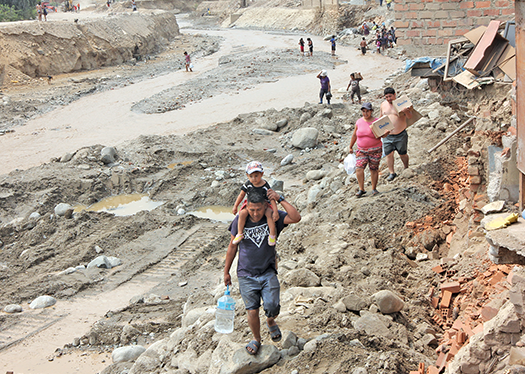
People carry possessions from homes they lost during flash flooding in a neighborhood on the east side of Lima, Peru, during an El Niño in 2017. (Photo by Barbara Fraser) .
Unusually warm water pooling in the western Pacific Ocean has triggered headlines warning of a looming El Niño that could rival some of the fiercest in recent decades. But Uruguayan climate expert Walter Baethgen, who studies the impacts of climate change and climate variability on agriculture at Columbia University’s Climate School in New York, is more cautious.
“The short answer is that today, it’s impossible to know how strong the El Niño will be,” Baethgen told EcoAméricas in April. And a month later, he was still hesitant to predict an El Niño. That’s because forecasts are based on climate models, some of which use historical data while others use current physical data from monitoring oceans and atmospheric conditions. While nearly two dozen models indicate a high probability of an El Niño later this year, only over the next couple of months will scientists be able to say with greater certainty when it would arrive and how strong it is likely to be.
An El Niño occurs when the trade winds that typically blow east to west across the tropical Pacific weaken, allowing a mass of warm water to move eastward from the western Pacific to the northern coast of South America—and sometimes as far north as the U.S. state of California. The phenomenon, which is also affected by atmospheric and ocean conditions in other parts of the world, upends normal weather patterns, causing flooding on Peru’s normally arid coast and unusually dry conditions across the Amazon and in Central America.
The cycle of an El Niño—and its opposite, La Niña—typically begins in the period April to June and peaks sometime during October to February. The pattern usually lasts a year or less, although in some cases has spanned a two-year period, according to the Columbia Climate School’s International Research Institute for Climate and Society. But there is still much that scientists don’t know: What causes the mass of warm water to accumulate? As trade winds weaken, the water warms, further weakening the winds, but which comes first, and what triggers it? Why do models predict an El Niño some years, only to have the warm water dissipate and normal conditions return?
Planning is key, despite uncertainties
Despite the lingering questions, the huge amounts of data available, including measurements from a network of buoys across the Pacific, have made models increasingly helpful—“skillful” is Baethgen’s term—in predicting events, although forecasts come with caveats.
“Not all El Niños are the same,” says Peruvian climatologist José Marengo, senior scientist at Brazil’s National Center for Monitoring and Early Warning of Natural Disasters (Cemaden). Differences depend on various factors, including Pacific sea-surface temperatures, whether warm water is concentrated in the central or Eastern Pacific, and on conditions elsewhere in the world, including the Atlantic and Indian oceans. Scientists mull how those factors interact, tweaking the models as they learn more.
Nevertheless, says Baethgen, there are some general characteristics. For instance, El Niño tends to bring greater-than-usual rainfall to the equatorial Pacific; coastal areas of Ecuador and northern Peru; northern and northeastern Bolivia; Paraguay, Uruguay and northern Argentina; and parts of southern Argentina and Chile.
However, the weather pattern usually also causes drier-than-normal conditions in the Amazon region, northeastern Brazil, virtually all of Central America and the southern half of Mexico.
Forecasts allow farmers in those areas to plan ahead by increasing or decreasing their planting areas, adjusting their crop mix, storing water or boosting irrigation, for example. In regions where scientists don’t typically see a pattern, however, farmers must simply take their chances, Baethgen says.
Central America among hardest hit
Planning is especially critical in Central America, where most of the population lives in the area known as the Central American dry corridor, where an El Niño would cause lower precipitation than usual. Even under normal conditions, the corridor receives only 1,500 to 2,000 millimeters (59 to 79 inches) of precipitation annually, compared to twice that amount or more in the region’s other tropical forest areas.
Although soil and vegetation in the corridor are adapted to withstand periodic droughts, the impacts on humans can be severe. Such was the case during the 1997-1998 El Niño and also in 2007-2008 and 2015-2016, says geographer Adolfo Quesada-Román, a researcher at the University of Costa Rica. More frequent dry spells since 2000 have been complicated at times by sudden swings in which a low-precipitation year is followed by heavy rains and flooding.
A strong El Niño affects both rural and urban residents, and preparations must begin early, Quesada-Román says. In the past, farmers have used nature-based solutions, capturing rainwater and producing and storing forage crops, adding salts to livestock feed so the animals retain water, and reducing their livestock’s range. Common crops most affected include rice, melons, sugar cane, coffee and some fruits, he says. But although farmers can prepare somewhat by improving their fertilizing techniques, they will still have smaller harvests.
Central America’s urban areas are also hard hit by an El Niño. Although use of wind, solar and geothermal energy is growing in the region, Central America remains highly dependent on hydroelectricity. Planners should start early to conserve as much water as possible in reservoirs until more normal rainy conditions begin to return, Quesada-Román says, noting this might not happen until the second quarter of 2027—or beyond, if an El Niño arrives later this year. When countries run out of hydropower, they fall back on diesel fuel, which is expensive and contributes to global warming.
Those reservoirs may also be a source of drinking water, making water conservation doubly important. Besides storing water, planners should ensure rational use of both water and electricity from the outset, to avoid sharp reductions later that would have a greater impact on jobs and food security, Quesada-Román says.
Above all, the region should learn from experience by examining how the impacts of droughts over the past three decades “are reflected in public policies, laws, agricultural extension, electricity generation and provision of potable water, [to see] what policy decisions were made and what changed,” he says. “If we come to the conclusion that they’re the same municipalities, the same sectors and with a similar degree of impact, it means we haven’t learned anything.”
If an El Niño does occur this year, it will provide data for that kind of study, as well as others that are only possible every 15 years or so, such as the impact of increased rainfall on Peru’s coastal dry forest or South America’s tropical glaciers. In Brazil, biologist Philip Fearnside at the National Institute of Amazonian Research (Instituto Nacional de Pesquisas da Amazônia, INPA) in Manaus says that there is still much to learn about how drought affects individual Amazonian watersheds.
Climate scientists will continue to refine their models, but Baethgen worries about the future of El Niño forecasting as a result of U.S. cuts to climate research funding under the Trump administration. “What has been hurt most is probably not the monitoring [or] data gathering, but the processing, the research,” he says. “The United States is a leader in improving models to forecast El Niño, and we’re losing precious time.”
- Barbara Fraser
In the index: A woman stands amid the ruins of her house on the bank of the Huaycoloro River in Lima, which surged during flash flooding on Peru’s desert coast caused by an El Niño in 2017. (Photo by Barbara Fraser)