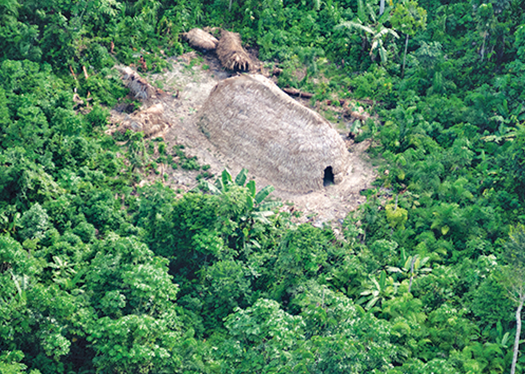
This longhouse, built by isolated Indigenous people, occupies Brazil’s side of a Peruvian-Brazilian border area where a protected corridor has been proposed. (Photo by Peetsaa/Acervo CTI)
Two decades after Peru passed legislation to protect semi-nomadic Amazonian Indigenous groups that shun contact with the wider society, two new reports highlight growing threats to the forests where these people live. Road projects, timber concessions, and illegal gold mining and drug trafficking driven by organized crime imperil Indigenous groups as well as Peru’s carbon emission-reduction commitments, which include protection of reserves set aside for these groups. “All these pressures can have very delicate impacts on isolated peoples, considering their vulnerability,” says anthropologist Beatriz Huertas, who has studied isolated groups for decades and worked to design measures to protect them. (See Q&A—this issue.) “Road-construction projects, meanwhile, can involve the proliferation of illegal activities, colonization, and ultimately a series of interrelated activities.” South America has the world’s largest number of semi-nomadic people, with most of them living in the Amazon basin and the Chaco region... [Log in to read more]