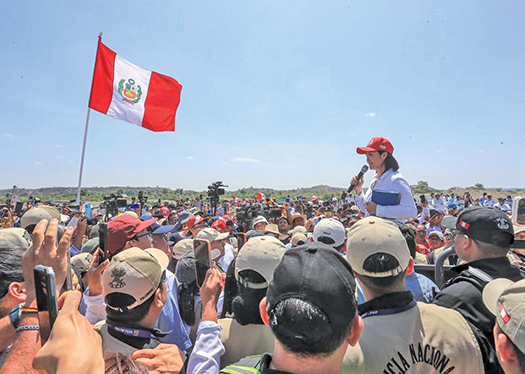
President Keiko Fujimori promoted El Niño preparedness during a visit to the northern city of Piura on Aug. 3, just a week after her inauguration. (Photo courtesy of Peruvian government)
Just seven days after taking office, Peruvian President Keiko Fujimori stood in the bed of a pickup truck in the northern city of Piura to address a smattering of government workers, police and journalists accompanying her. In the background, yellow bulldozers churned through a dry riverbed, removing rubbish and sediment.
The tractors were clearing the way for outsized stormwater flows expected from El Niño, the periodic, world-weather-altering phenomenon driven by higher-than-normal sea temperatures in the eastern tropical Pacific.
“Our top priority is saving lives,” Fujimori said from the pickup during her Aug. 3 Piura visit. “The second is [protecting] agriculture.”
The U.S. National Oceanic and Atmospheric Administration (NOAA) forecasts a 69% chance that this year’s El Niño will be the strongest ever documented. That’s saying something, given how previous El Niño events have taken lives, destroyed crops and thwarted economic growth.
So Fujimori and her administration find themselves scrambling to prepare, mindful that policy plans they’ve drawn up for the country could be eclipsed by the consequences of El Niño weather events in a matter of days.
During Fujimori’s appearance in Piura, it was hard to imagine that in the hot, dry landscape surrounding her, rivers could soon burst their banks, crops could rot in the fields and buildings could collapse. But as she and her compatriots know all too well, El Niño can bring heavy rainfall and flooding to northern Peru while causing drought in the south, the Andes and the Amazon.
El Niño forms every two to seven years. It begins with a weakening of the east-west trade winds that blow from the Americas toward Australia and Indonesia. Since trade winds typically drive warm surface water toward the western Pacific, causing colder water to rise along the Peruvian coast, the weakening—and sometimes the reversal—of these winds dampens the ocean upwelling. This spells warmer-than-usual water temperatures in the eastern tropical Pacific, with heat from the water rising into the atmosphere, shifting the Pacific jet stream and altering weather patterns around the globe.
An El Niño is considered strong if the water in the Pacific is 1.5 degrees Celsius warmer than average. In 2015, when one of the strongest recorded El Niños occurred, the water was 2 degrees warmer. The extreme weather resulted in floods in Peru and California, wildfires in Australia and Indonesia, and severe drought in parts of Africa, among other consequences.
Forecasts for this El Niño suggest sea-surface temperatures could be 3 degrees warmer than average—stronger than ever, due in part to human-induced climate change.
Budgeting for damage
This could lead to unprecedented events. Fujimori’s administration has identified 380 critical points for intervention and allocated 450 million soles (US$134 million) to address them, with 140 million soles (US$41 million) reserved for the Piura region.
Tuk-tuk driver Rony Espinoza lives in this region’s coastal village of Lobitos. “When El Niño is here, we’re isolated,” he says. “There’s no food, potable water, electricity or phone reception. Stomach diseases spread because we drink rainwater we collect from our roofs.”
Lobitos, a fishing town of 1,300, lies nine miles from the city of Talara, where the nearest market is located. Next to nothing grows in the arid landscape: people live off fishing and surf tourism. When El Niño rains start, the road between Lobitos and Talara floods, and supplies for the town must be delivered by boat. Residents install a communal kitchen and this year are fundraising to buy water filters for homes in hopes of staving off stomach illnesses. Espinoza will be in charge of maintaining the filters.
El Niño is also a concern for Peru’s Central Reserve Bank. The bank’s latest inflation report, issued in June, forecasts this year’s GDP-growth will be 0.8% lower than it could be, due to El Niño. Crops including fruit, potato and rice will suffer from either excess rainfall or drought. At a ceremony in July, the central bank’s president, Julio Velarde, used his speech to highlight the possible impacts of El Niño.
“[T]here’s a serious problem that’s going to hit us: El Niño,” he said. “Perhaps the [economic] figures we’ll see in the coming months won’t be so good. […] The fish industry has already fallen by 74%.”
Fishing is one of the first industries impacted by El Niño because it all starts with the warmer-than-usual ocean water, which contains fewer nutrients than the colder water that wells up when trade winds are blowing normally. Peru is the world’s largest producer of fish meal made from anchovy, accounting for 20% of global production. Warmer ocean conditions push anchovies into deeper waters and increase the proportion of juveniles in catches.
Fishing suspended
To protect the fish population for next year, the Peruvian government suspended anchovy fishing in June until further notice. This is already impacting fish farmers worldwide, who use Peruvian fish meal to feed farmed species such as salmon. Since last year, fish meal prices have risen by 80%. Such disruptions might only intensify in the future. Noting the strengthening of El Niños in recent decades, José Luis Ticona of Peru’s National Meteorology and Hydrology Service says: “El Niño becomes more dangerous every time.”
Peru has failed to match the rising risk with improved preparedness, observes agronomic engineer Ana Sabogal of Pontificia Catholic University of Peru. “Recently, we had a tiny bit of rain and areas of Lima flooded,” says Sabogal, director of the university’s Institute of Nature, Earth and Energy. “The roofs are flat and there is no adequate sewage system.”
Sabogal fears El Niño will displace people, cause floods and spur insect-borne diseases such as dengue. She cites weather changes around the world, including the hot summer in Europe. “We need to realize these changes are here for the long term,” she says. “We should anticipate rather than respond.”
A recently issued policy plan the new administration presented to Congress blames the previous government for “an absolute delay in El Niño prevention works.” At her recent appearance in Piura, Fujimori was adamant, calling out loudly from the back of the pickup truck: “There is a lot of work to be done!”
- Noah Moeys