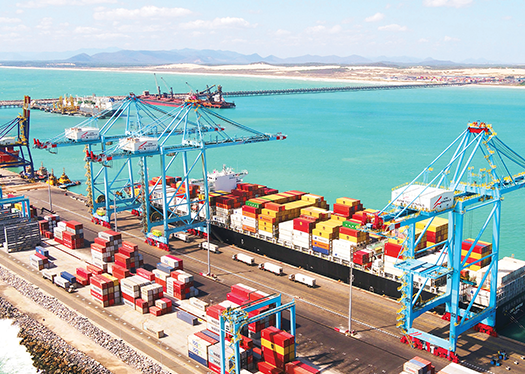
An aerial view of Brazil’s Port of Pecém, where plans are underway to export green-hydrogen-based ammonia to European markets. (Photo courtesy of Gladison Oliveira, Pecém Industrial Complex)
The recent start-up of a small, commercial-scale green-hydrogen plant has raised hopes that Brazil in the not-distant future will dramatically ramp up low-carbon production of hydrogen for use as a green fuel and industrial feedstock.
White Martins, the largest industrial-gas producer in South America, began operating the green-hydrogen plant on April 15 in Jacareí, a city in São Paulo state. The company, a subsidiary of the British-based industrial-gas supplier Linde, said the wind- and solar-powered plant will manufacture 800 tons of green hydrogen a year for a glass manufacturer and for other industrial customers in São Paulo state and neighboring Rio de Janeiro and Minas Gerais states.
Though it is Brazil’s first commercial green-hydrogen plant, the Jacareí facility will not have the capacity of the larger-scale green-hydrogen operations planned for Brazil and other countries in Latin America.
Plans for one such plant in Areia Branca, Rio Grande do Norte state, call for solar- and wind-driven production of up to 80,000 tons of hydrogen annually—100 times the output of the Jacareí facility. That project, called Morro Pintado, received a state environmental permit on April 21. If built as planned, the plant will use all the green hydrogen it produces to supply a massive, 450,000-tons-per-year ammonia factory slated to be constructed alongside it.
Hydrogen is an essential ingredient in the production of ammonia, which, in turn, is a key component of the nitrogen fertilizers Brazil’s enormous agricultural industry uses extensively.
Promoters of green hydrogen are heartened by the Jacareí plant’s start-up and by the growing number of plans in Brazil for far larger green-hydrogen facilities. They also welcome emerging plans for hydrogen-export facilities that will ensure the sustainably made gas can be sold abroad, not just in the domestic market—capitalizing on the country’s comparative advantages.
“Brazil is a very promising green hydrogen market because its electricity matrix is composed of [nearly] 90% renewable energy—and an even greater percentage of that matrix in some regions of the country—and has low-cost, surplus, renewable wind and solar power, ” says Simon Byrtus, a partner in Green Investors, a German firm participating in the Morro Pintado project.
Government figures show renewable power currently accounts for 86.8% of Brazil’s electricity matrix, with hydroelectricity providing 52.1%, wind power 14.9%, solar 11.4%, and biomass—made from organic matter ranging from sawmill waste to sugarcane fiber—8.4%. Fossil fuels comprise 11.2% and nuclear power 2%.
Green hydrogen, known as GH2, is viewed as environmentally superior to conventional hydrogen because, unlike the latter, its production does not involve the use of fossil-fuel inputs such as coal, oil or natural gas, which cause heavy carbon emissions. Instead, the hydrolytic process used to break water into its component oxygen and hydrogen is driven by renewable energy such as solar, wind or hydroelectric power.
The heart of the Jacareí facility is a 5-megawatt (MW) electrolyzer unit powered by wind turbines and a dedicated solar array. Because it exceeds the pilot-project size of Brazilian green-hydrogen plants built to date and will sell its hydrogen for industrial uses, the facility is “a pioneer,” Gilney Bastos, president of White Martins and Linde in South America, said in April. He described the plant as “extremely well located, both strategically and logistically, being in or near Brazil’s three most industrialized states.”
Some 20% of the plant’s production will be used to fuel glass-melting furnaces at the Cebrace glass factory in Jacareí. By switching to green hydrogen from fossil fuel to power its furnaces, Cebrace will reduce its carbon-dioxide emissions by an estimated 1,610 tons annually, the White Martins press release said.
The remaining 80% of the Jacareí plant’s 640-ton annual output will be sold for use as fuel or a feedstock in metallurgical, chemical, and food-processing plants, the press release said.
“The announcement of the White Martins Jacareí plant, as well as other [larger]-scale GH2 plants to be built in Brazil in the near future, is positive because they will help meet demand in the face of more price-competitive fossil fuels,” says Victoria Santos, manager for energy and industry at the Institute for Climate and Society (ICS), a nonprofit that finances Brazilian climate-change mitigation projects.
One of the principal uses expected of green hydrogen in Brazil—as in the case of the planned Morro Pintado complex—is to serve as a feedstock for the manufacture of ammonia. Ammonia’s wide variety of industrial uses includes the production of fertilizer for Brazil’s massive agricultural industry.
To supply the quantities required, the green-hydrogen plants will have to conduct hydrolysis on a large scale and find the renewable energy to power it. The Morro Pintado project, with a planned investment of 1 billion euros (US$1.18 billion), aims to use wind and solar power to drive a 500-megawatt electrolyzer unit to produce green hydrogen.
Morro Pintado is being carried out by partners including thyssenkrupp Uhde and Siemens, German engineering companies that collaborate on green-energy projects; Andritz, an Austrian-based international technology group; as well as Brazil Green Energy and Green Investors—Brazilian and German firms that, respectively, develop sustainable-energy infrastructure and GH2 projects.
Simon Byrtus, a partner in Green Investors, says Morro Pintado will cut its carbon emissions dramatically by producing ammonia with a hydrogen feedstock made from renewable-power-driven electrolysis rather than from processes that involve fossil fuel—usually natural gas.
Expecting strong world demand for green hydrogen and green ammonia, Brazil is developing plans for hubs that integrate their manufacture, storage and shipment at seaports serving European and U.S markets.
The main such effort currently is a R$42 million (US$8.2 million) project being developed at Pecém, in the northeastern coastal state of Ceará. Pecém is the site of Brazil’s closest port to Europe. In 2024, the Ceará state government and the Netherlands reached an agreement aimed to facilitate eventual GH2 and green ammonia exports to Europe.
Nearly all GH2 and green-ammonia producers planning to operate in Ceará will be located in a 6,180-hectare (24-square-mile) free trade zone set up by the state, six kilometers (3.7 miles) from the Port of Pecém. Plans call for them to be directly connected to a pipeline that can transport GH2 and green ammonia to the port, exempting those goods from export taxes, Joaquim Rolim, the sustainable development manager of the Federation of Industries of Ceará State (FIEC), told EcoAméricas.
“The Ceará state’s free trade zone and the Port of Pecém’s proximity to Europe, strategically make it the lowest-cost place in Brazil for producing and exporting GH2 and green ammonia,” Rolim said. “The state’s competitiveness is also guaranteed by its GH2 producers’ ability to receive cheap, nearby solar and wind power from Ceará or neighboring northeastern states, whose year-round sunshine and strong and constant coastal trade winds have made the northeast region the largest supplier of solar and wind power in Brazil.”
More than 40 companies have signed non-binding Memorandum of Understanding (MoU) agreements with the Ceará state government or with Pecém’s port authority to build GH2 plants near the port and many are drafting feasibility studies, Rolim told EcoAméricas. Their efforts could benefit from World Bank plans, announced in July 2025, to invest US$134 million in the development of a Port of Pecém green-hydrogen center.
Among those planning to bring GH2 projects online by 2030 are: Fortescue, an Australian mining company; the Qair Group, a French renewable energy producer; Électricité de France (EDF), a French electric-utility company; Fotowatio Renewable Ventures (FRV), a Spanish-based developer of renewable energy projects; Voltalia, a French renewable energy group; and Casa dos Ventos Energias Renováveis (House of the Winds Renewable Energies), a Brazilian company that develops, builds and operates wind and solar farms, associated with TotalEnergies, a French multi-energy company, Rolim told EcoAméricas.
Fortescue is planning one of the world’s largest GH2 plants at Pecém, with an initial output of 500 metric tons daily, or 182,500 tons annually, and an electrolyzer unit using 1.2 gigawatts of renewable energy. The green hydrogen generated will enable green ammonia production of 4,725 tons daily, says the company, which has not announced when operations will begin.
A second GH2 production and export hub is planned at the Port of Açu, in Rio de Janeiro state, where three companies plan GH2 plants to enable green-ammonia production.
Also driving interest in GH2 projects is a 2024 law that sets up a regulatory framework for low-carbon hydrogen output in Brazil. The legislation provides guidelines for GH2 production and certification, and creates federal tax incentives and legal protections for producers.
Even some supporters of the 2024 law argue more needs to be done to incentivize production of green hydrogen. “The law is instrumental in advancing GH2 production in Brazil, but lacks the incentives needed to balance the cost of products derived from GH2, like green fertilizer, green iron and steel, and green aviation and marine fuel, to make these derivatives more price competitive with similar conventional products,” says the ICS’s Santos.
Still, experts say Brazil has the potential to become a world leader in green-hydrogen production. A study by the U.S.-based consulting firm McKinsey & Company estimates Brazilian-made GH2 could generate US$15-20 billion annually by 2040 with most of that amount—some US$10-12 billion—coming from sales to energy-intensive domestic sectors such as trucking and steelmaking. An estimated US$4 to 6 billion could come from exports of green-hydrogen derivatives to the United States and Europe, the McKinsey study says.
Opportunity at home and abroad
The study cites Brazil’s competitive advantages, including low-production costs, abundant wind and solar energy potential, an integrated, low-carbon power grid, potentially strong domestic demand, and proximity to Europe and the East Coast of North America.
The prospect of Brazil exploiting these advantages heartens scientists, environmental advocates and government officials seeking to wean Brazil’s economy from fossil fuels. As green hydrogen illustrates, they say, a shift to renewables could bring economic opportunity as well as environmental benefits.
“If this McKinsey & Company study estimate is correct, that Brazil could receive US$4 to US$6 billion annually in export revenues from the sale of green-hydrogen derivatives to Europe and the USA, this would greatly boost its trade surplus, giving Brazil a huge economic advantage,” says Carlos Nobre, a Brazilian climate and earth-system scientist. “And the production of green hydrogen, which causes near-zero carbon emissions, to replace, in part, the production of gray or traditional hydrogen, which releases such emissions, would help the country meet its updated Paris climate-agreement GHG emissions reductions targets.”
Nobre, who co-chairs a UN-sponsored panel of scientists tracking the health of the Amazon biome, notes the goal of producing green hydrogen at scale will become easier to achieve as the cost of solar- and wind-power generation continues to decline. He notes conflict such as the war in Iran will make green hydrogen increasingly competitive.
“Such an economic and ecological advantage for Brazilian GH2 would not only reduce environmental damage done by the production of fossil fuels in Brazil, but also help diversify the country’s economy, whose industrial sectors rely on fossil fuels and minerals,” Nobre says. “Because GH2 is clean—causing near-zero carbon emissions—it and its derivatives, like green ammonia, should have a competitive price advantage over similar non-green products made by using traditional or gray hydrogen, which requires fossil fuels to produce, especially if fossil fuel prices remain high.”
Unanswered questions
Vinicius Oliveira da Silva, a public policy specialist at the Institute of Energy and Environment (IEMA), a Brazilian nonprofit, sounds a note of caution. He calls McKinsey’s estimates “quite optimistic, perhaps overly so,” arguing “several unknowns” remain.
“One unknown is the extent to which the Brazilian government will subsidize the GH2 industry and those of its derivatives, like green ammonia, by providing them with tax breaks and other fiscal incentives, a decision which could mean it’s not subsidizing more competitive non-green products,” he says. “Another unknown is the extent to which domestic and foreign buyers of GH2 and its derivatives will be willing, at least initially, to pay higher prices for GH2 and its derivatives.”
Adds Oliveira da Silva: “Also the extent to which GH2 and its derivatives could help Brazil reach its updated Paris agreement greenhouse-gas-reduction targets by 2035 is also based on similar unknowns, like whether domestic and foreign buyers of these green products will, at least initially, be willing to pay the higher prices for them. Another unknown is the extent to which Brazilian companies can produce GH2 and its derivatives in significant volumes, and have the cost-based logistics in place to deliver them, well before 2035.”
- Michael Kepp
In the index: White Martins recently started up Brazil’s first commercial green-hydrogen plant in Jacareí, São Paulo state. (Photo courtesy of White Martins)